
When I walked into my client’s data center in early 2026, the first thing I noticed wasn’t a rack of servers—it was a wall of digital certificates, policy‑as‑code files, and a dashboard flashing “Zero Trust Enabled: 100%”. The transition from perimeter‑based fences to a relentless verification mindset has finally hit the critical mass. If you’re a developer or architect still asking “why zero trust now?”, the answer lies in the convergence of three forces: hyper‑distributed workloads, AI‑augmented attackers, and regulatory pressure that treats breaches as corporate negligence.
1. Zero Trust is Now a Platform, Not a Checklist
In 2020, most vendors offered a Zero Trust Framework—a set of recommendations that required you to stitch together identity providers, micro‑segmentation tools, and endpoint detection solutions. By 2026 those point solutions have coalesced into integrated platforms that expose a single API surface for policy definition, telemetry ingestion, and automated remediation.
Modern platforms (e.g., Cloudflare Zero Trust Platform, Palo Alto Cortex XSOAR) let you write policies in familiar languages like YAML or Rego, store them in Git, and trigger enforcement via webhooks. The result is a true “policy‑as‑code” pipeline that can be version‑controlled, tested with unit‑style assertions, and rolled back with a single commit.
Developers now treat security policies the same way they treat feature flags—adding them to CI pipelines, reviewing them in pull requests, and measuring impact with observability tools.
2. Identity Everywhere: Beyond Users to Machines and Data
Zero Trust 1.0 focused on authenticating human users. In 2026 the perimeter‑less world demands that every request—whether from a serverless function, a container, or a sensor—carry a verifiable identity. The rise of SPIFFE (Secure Production Identity Framework for Everyone) and SPIRE as the de‑facto standard for service identity means that workloads can automatically obtain short‑lived X.509 certificates from a mesh‑wide trust authority.
Practically, this translates to three developer‑facing changes:
- Embedding a
serviceidentitylibrary in every microservice to fetch and rotate certs without code changes. - Using
Bearer Tokenexchange flows that bind the token to both the caller’s identity and the intended resource (OAuth 2.0 & UMA extensions). - Annotating data stores with access tags that match service identities, enabling attribute‑based access control (ABAC) at the data‑layer.
When identity is baked into the fabric, the classic “who, what, when, where” matrix collapses into a single cryptographic proof.
3. Micro‑Segmentation Has Gone Reactive—Enter Predictive Segmentation
Traditional micro‑segmentation relied on static network zones. After a breach in early 2025, analysts discovered that attackers could pivot through “trusted” zones faster than operations could update firewall rules. The industry reaction was to adopt AI‑driven segmentation.
Predictive segmentation continuously analyses flow telemetry, machine‑learning risk scores, and business context to auto‑generate “conditional zones”. For example, an API gateway might automatically place a high‑risk request from a new IP into a quarantine segment, enforce MFA, and only lift the restriction after a risk engine confirms legitimacy.
From a developer standpoint, the only change is to tag services with business‑criticality levels (critical, high, medium, low) and let the platform adjust network policies on‑the‑fly. This reduces the operational overhead of manual rule updates by up to 70% in large enterprises.
4. Observability as the Glue Between Trust and Enforcement
Zero Trust is only as strong as its visibility. In 2026, the observability stack—metrics, logs, traces, and especially policy telemetry—feeds directly into enforcement loops. Anomalous latency spikes or error‑rate bursts can trigger a policy that forces a service into a “read‑only” mode while an automated investigation runs.
Key components include:
- Policy Decision Point (PDP) logs: Every decision (allow, deny, challenge) is recorded with a request ID that can be correlated to trace data.
- Risk Engine: A real‑time scoring service that ingests telemetry, external threat intel, and user behavior analytics to produce a numeric confidence score.
- Policy Enforcement Point (PEP) hooks: Lightweight sidecars that can reject traffic without contacting the central PDP when the risk score exceeds a threshold.
By unifying these signals, developers can write “self‑healing” code that reacts to security events the same way they react to performance alerts.
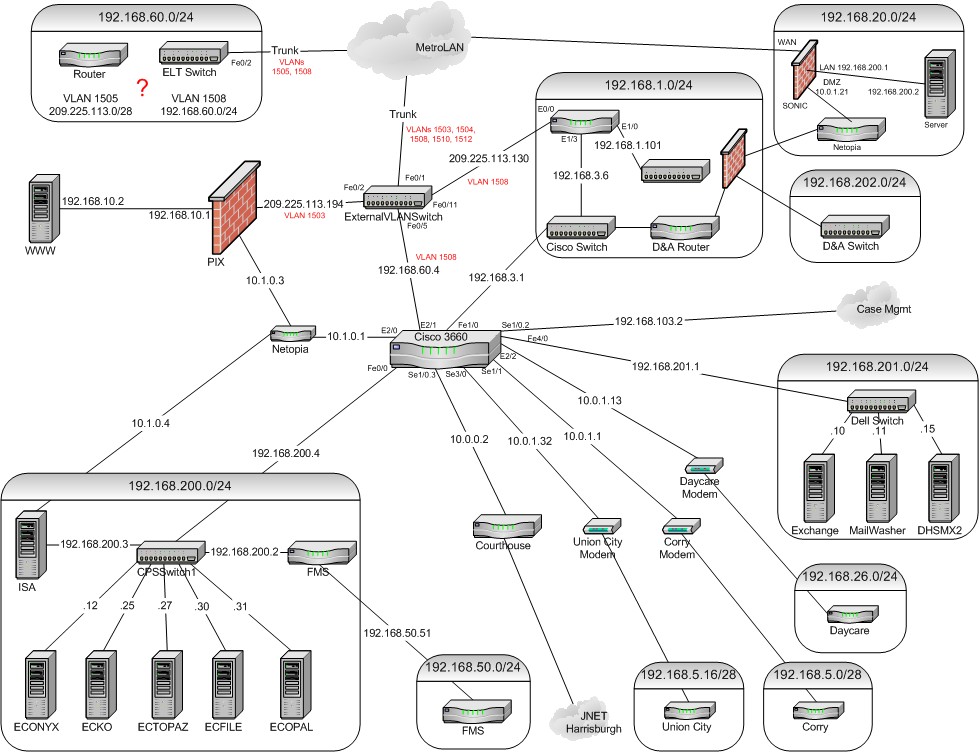
Image: DHS Network Topology — No machine-readable author provided. Dantic assumed (based on copyright claims). (CC BY-SA 3.0), via Wikimedia Commons
5. Zero Trust for the Supply Chain: Bill of Materials (BOM) Verification
The SolarWinds and Log4j incidents taught us that trust extends beyond runtime. In 2026 the standard practice is to generate a Software Bill of Materials (SBOM) for every artifact, sign it with a cryptographic key, and verify it at deployment time.
Platforms now refuse to instantiate a container unless its SBOM matches a whitelist stored in a secure registry. CI pipelines automatically fail builds if a newly introduced dependency introduces a known CVE, and the failure reason is surfaced as a policy violation in the Zero Trust console.
For developers, the workflow is straightforward: run syft or cyclonedx as part of the build step, publish the SBOM to the policy store, and let the platform enforce it. The mental model shifts from “move fast and break things” to “move fast, but only with verified components”.
6. The Rise of Zero Trust as a Service (ZTaaS)
Small‑to‑mid‑size enterprises (SMEs) often lack dedicated security teams. ZTaaS providers bundle identity federation, micro‑segmentation, and policy telemetry into a managed SaaS offering. What used to require a multi‑vendor stack now costs a predictable monthly fee.
Key benefits include:
- Instant onboarding through OpenID Connect federation.
- Pre‑built policy templates for common compliance regimes (PCI‑DSS, HIPAA, GDPR).
- Automatic scaling of enforcement points via serverless edge functions.
From a developer’s perspective, integration is a matter of adding a few environment variables and invoking the provider’s SDK. The heavy lifting—certificate rotation, risk scoring, and audit logging—is abstracted away.
7. Regulatory Alignment: Zero Trust as a Legal Baseline
By mid‑2026, several jurisdictions (EU, Singapore, California) have published draft legislation that treats “reasonable security” as synonymous with “Zero Trust architecture”. Auditors now request evidence that every data access request was evaluated against a risk‑based policy.
This regulatory shift forces enterprises to embed Zero Trust artifacts—policy files, audit logs, and SBOM signatures—into their compliance artifact repositories. Automated compliance checks run nightly, flagging gaps before any external audit.
Bottom Line
Zero Trust is no longer a “nice‑to‑have” add‑on; it is the operating system of modern enterprise security. By embracing platform‑centric policy‑as‑code, pervasive workload identity, predictive segmentation, and supply‑chain verification, development teams can ship faster while staying compliant and resilient against sophisticated threats. The real competitive advantage in 2026 will belong to organizations that bake these capabilities into their CI/CD pipelines and treat security decisions as first‑class citizens in their codebases.
Sources & References:
1. NIST Special Publication 800‑207, “Zero Trust Architecture” (updated 2025).
2. Cloudflare Blog, “Zero Trust Platform Evolution”, March 2026.
3. OpenSSF, “Software Bill of Materials – Best Practices”, 2025.
4. Gartner, “Zero Trust as a Service Market Forecast 2026”.
5. EU Commission, “Regulatory Draft on Zero Trust Security”, 2026.
Disclaimer: This article is for informational purposes only. Technology landscapes change rapidly; verify information with official sources before making technical decisions.