
WebAssembly (WASM) has quietly revolutionized web development, enabling near-native performance in browsers while maintaining web security standards. Since reaching its 1.0 specification in 2017 and achieving universal browser support, WASM has found its way into production applications across diverse industries, from Adobe Photoshop on the web to cryptocurrency mining platforms.
As developers, understanding when and how to leverage WebAssembly can be the difference between a sluggish web application and one that delivers desktop-class performance. With wasm and WASI already having a tremendous amount of capabilities that we can start using right now, and WebAssembly's use in commercial applications constantly growing, 2024 marks a pivotal moment for widespread adoption.
Performance That Actually Matters: When WebAssembly Shines
The question isn't whether WebAssembly is faster than JavaScript—it's understanding where that speed translates to meaningful user experiences. Recent benchmarks reveal nuanced performance characteristics that every developer should understand.
When benchmarks are tested with extra-small or small input size, WebAssembly is faster than JavaScript in almost all benchmarks (97.6% and 95.1% for extra-small and small respectively). On average, WebAssembly achieves a speedup of 26.99x for extra-small and 8.22x for small. However, the picture becomes more complex with larger datasets, where when the input size increases to medium, there are 18 benchmarks of which WebAssembly becomes slower than JavaScript.
More recent data from 2024 shows even more impressive gains in specific scenarios. Benchmarks from late 2025 demonstrate that WASM with SIMD can achieve 10-15x speedups over pure JavaScript for these types of workloads, particularly for parallelizable computations.

The key insight? WebAssembly excels at computationally intensive tasks with smaller data inputs, while JavaScript's just-in-time compilation can sometimes match or exceed WASM performance on larger datasets due to better memory management optimizations.
Real-World Applications Driving WebAssembly Adoption
WebAssembly has moved far beyond proof-of-concept demos. Based on the Chrome Platform Status metrics, the number of websites using wasm has increased by a little over 1% again this past year to now sit at close to 4.5%. Every year, we hear about different commercial applications adopting WebAssembly. From video conferencing software like Zoom and Google Meet, software like Figma and AutoCAD web, and social media applications like Snapchat and Pinterest.
Some standout implementations demonstrate WebAssembly's versatility:
eBay's Barcode Scanner: eBay implemented a WebAssembly-based barcode scanner to enhance their mobile web selling experience. Previously limited to native apps, this feature uses an in-house C++ library compiled to WebAssembly, providing consistent performance for barcode detection from camera streams. This innovative approach significantly improved the listing process, demonstrating WebAssembly's potential in complex, real-world web applications.
Google Earth: Google Earth's web version is a prime example of WebAssembly's capabilities. Initially, Google Earth required native applications or plugins due to its intensive demands. With WebAssembly, Google successfully compiled Google Earth's core to run efficiently in browsers, eliminating the need for additional downloads.
Figma's Performance Innovation: By June 2025, Figma expanded its use of Wasm with "code layers" in Figma Sites. Using tools like esbuild and Tailwind v4 compiled to Wasm and executed inside Web Workers, Figma achieved a notable performance boost for real-time bundling and style compilation directly in the browser.
Beyond Browsers: WASI and the Server-Side Revolution
WebAssembly's most exciting developments are happening outside the browser. The WebAssembly System Interface (WASI) has matured significantly, with WASI advancing to Preview 2 early in 2024 and introducing groundbreaking capabilities.
WASI (WebAssembly System Interface) gives WebAssembly modules the ability to access system resources—files, network, clocks, random numbers—in a secure, portable way. This transforms WebAssembly from a browser-only technology into a universal runtime.
The implications are profound. Solomon Hykes, a co-founder of Docker, wrote in 2019, "If WASM+WASI existed in 2008, we wouldn't have needed to create Docker. That's how important it is. WebAssembly on the server is the future of computing."
Current WASI Capabilities:
- File system access with capability-based security
- HTTP networking through the wasi-http world
- Command-line interface support via wasi-cli
- Cross-platform binary portability
- Sandboxed execution with explicit permissions
However, challenges remain. An academic evaluation of WASM "micro-container" performance found that a WASI-based server could only utilize one CPU core and saw severely reduced throughput compared to a native container because "the Wasm container does not support multi-threading". The study concludes that the "lack of multi-threading severely limits its use cases".
The Component Model: WebAssembly's Composability Breakthrough
One of 2024's most significant WebAssembly developments is the maturation of the Component Model. The WebAssembly Component Model stands as one of the most significant architectural advancements to stabilize in the past year. Released as part of WASI Preview 2 (also known as WASI 0.2) in early 2024, this model provides a standardized, language-agnostic mechanism for composing larger applications from smaller, independent WebAssembly components.
This breakthrough enables unprecedented interoperability. The Component Model adds a fourth option: compile both to Wasm components and link them directly. They share memory, call each other's functions, and run in the same process—regardless of what language they were written in.
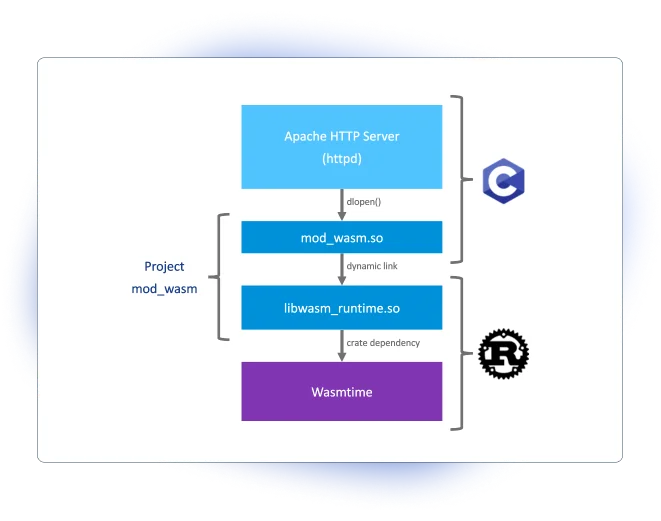
Image: Mod wasm.webp — Jesusgonzalezmarti (CC BY-SA 4.0), via Wikimedia Commons
The Component Model solves a fundamental problem in software development: language interoperability without the overhead of network calls or complex serialization protocols. A Rust cryptography library can be called directly from a Go web server, or a Python data processing module can integrate seamlessly with a C++ game engine—all running in the same memory space with type safety guaranteed.
AI and Edge Computing: WebAssembly's Next Frontier
The consensus was clear: WebAssembly has moved beyond experimental use cases and is actively powering production AI workloads today. The combination of WebAssembly's sandboxed security model and near-native performance makes it ideal for AI inference tasks.
Current AI applications include:
Browser-based ML: Developers are now running machine learning models directly in the browser using WASM. TensorFlow.js has a WASM backend that significantly improves CPU performance for inference tasks on devices without powerful GPUs. This enables real time AI features like object recognition and face detection in web apps.
Edge Computing: Edge computing: 100-500x faster cold starts than containers makes WebAssembly particularly attractive for serverless and edge environments where startup time is critical.
Production Scalability: The panelists shared real-world examples ranging from drone control systems to enterprise-scale video processing pipelines, demonstrating that WebAssembly AI applications are already operating at significant scale.
Major cloud providers are taking notice. Cloudflare Workers, Fastly Compute, and Fermyon Cloud are running Wasm in production at scale, validating WebAssembly's viability for production workloads.
When NOT to Use WebAssembly
Despite its impressive capabilities, WebAssembly isn't a universal solution. Understanding its limitations is crucial for making informed architectural decisions.
Avoid WebAssembly for:
- DOM manipulation: JavaScript remains superior for UI operations and web API interactions
- Simple CRUD applications: The compilation overhead isn't justified for basic business logic
- Small computational tasks: Transition only if your profiler identifies a computational bottleneck exceeding 5ms per call
- Rapid prototyping: The additional build complexity slows development iteration
- Memory-intensive operations: WebAssembly uses significantly more memory than their JavaScript counterparts
The current developer experience also presents challenges. In an October 2023 survey of developers, less than half of the 303 participants were satisfied with the state of WebAssembly. A large majority cited the need for improvement in four areas: WASI, debugging support, integration with JavaScript and browser APIs, and build tooling.
Getting Started: Practical WebAssembly Implementation
For developers ready to experiment with WebAssembly, the tooling ecosystem has matured significantly in 2024. Here's a practical approach:
Language Selection:
- Rust: Rust and C/C++ produce the best Wasm. Go (via TinyGo) is good but has limitations
- AssemblyScript: TypeScript-like syntax for easier adoption
- C/C++: Direct compilation of existing codebases
Development Workflow:
- Profile your application to identify performance bottlenecks
- Isolate computationally intensive functions
- Compile to WebAssembly using appropriate toolchains
- Integrate with JavaScript using generated bindings
- Test across different browsers and input sizes
Optimization Tips:
- Target
wasm32-simd128for an extra 2–4× speed boost over standard Wasm - Use Web Workers for non-blocking execution
- Optimize binary size with compiler flags
- Implement proper error handling for WASM module loading
The Bottom Line
WebAssembly in 2024 represents a mature technology ready for production use, but success requires strategic implementation rather than wholesale adoption. The performance gains are real and substantial for appropriate use cases—computationally intensive tasks, legacy code porting, and applications requiring sandboxed execution.
The emergence of WASI and the Component Model signals WebAssembly's evolution from a browser optimization tool to a universal runtime platform. While challenges around debugging, tooling, and multi-threading support remain, the trajectory is clear: WebAssembly is becoming the universal compile target for high-performance, portable applications.
For developers, the question isn't whether to learn WebAssembly, but when to apply it. Start with performance profiling, identify genuine bottlenecks, and gradually introduce WebAssembly where it delivers measurable improvements. The technology is ready—the key is applying it judiciously to maximize both performance and developer productivity.
Sources & References:
BenchmarkingWebAssembly — GitHub, 2024
Bytecode Alliance — WASI Documentation, 2024
Uno Platform — The State of WebAssembly 2024-2025, January 2025
Wasm I/O 2025 — Running AI Workloads with WebAssembly, May 2025
Daily.dev — WebAssembly for Web Developers: Getting Started with Wasm in 2026, January 2026
Disclaimer: This article is for informational purposes only. Technology landscapes change rapidly; verify information with official sources before making technical decisions.