
WebAssembly was born in the browser but has outgrown it. A comprehensive 2024 review of 121 security research papers on WebAssembly (arXiv:2407.12297) found that the technology is now deployed across "multiple and heterogeneous use-case scenarios" far beyond its original web context — from serverless edge computing to embedded systems and plugin sandboxes. Among all the languages that compile to Wasm, Rust has emerged as the dominant choice for production workloads where performance and security cannot be traded off against each other.
Why WebAssembly Matters Beyond the Browser
WebAssembly (Wasm) is a binary instruction format designed for portable, near-native execution. When it was introduced in 2017, it aimed at running computationally intensive code in web browsers — 3D graphics, video encoding, cryptography — without JavaScript's performance overhead. By 2026, it has become far more than that.
The key insight driving Wasm's expansion is its sandboxed execution model. Every Wasm module runs in a memory-isolated environment with no direct access to the host system's resources. This enables:
- Tenant isolation in multi-tenant cloud systems — each function is confined to its sandbox without a full VM or container overhead
- Untrusted plugin execution — applications like Figma and VS Code extension hosts use Wasm to run third-party code without risking the host process
- Edge computing at scale — platforms like Cloudflare Workers and Fastly's Compute@Edge execute Wasm modules in milliseconds at points of presence globally
- Portable server-side execution — via WASI (WebAssembly System Interface), Wasm modules run as server-side processes with controlled access to filesystem, networking, and clocks

Image: File:Rustc building paru with cargo screenshot.png — Rust Team / Screenshot (Apache License 2.0), via Wikimedia Commons
Why Rust Dominates Wasm Production Workloads
Multiple languages can compile to WebAssembly — C, C++, Go, AssemblyScript, and Python among them — but Rust has become the preferred choice for production deployments that prioritize correctness and security. The reasons are structural:
- No garbage collector: Rust's ownership model enables memory safety without a runtime GC. This means no GC pauses, no unpredictable latency spikes, and smaller Wasm binaries since no GC runtime needs to be bundled
- Memory safety guarantees: Rust eliminates entire classes of vulnerabilities — use-after-free, buffer overflows, data races — at compile time. In Wasm's context, where modules interact with host memory, this matters enormously
- First-class tooling: The
wasm-packandwasm-bindgentools, maintained by the Rust/Wasm working group, provide seamless compilation, JavaScript interop, and npm packaging - Minimal binary size: A minimal Rust Wasm binary can be optimized to well under 200KB with
wasm-opt, compared to larger Go binaries that bundle a full runtime - A deep crate ecosystem: With over 85,000 crates in the registry, most of Rust's standard library of async networking, serialization, and cryptography can compile directly to Wasm
Real Production Use Cases in 2026
Here is where Rust + Wasm is actively deployed in production systems today:
| Use Case | Platform / Example | Why Wasm Over Alternatives |
|---|---|---|
| Edge serverless functions | Cloudflare Workers, Fastly Compute@Edge | Sub-millisecond cold start vs. containers |
| Browser UI rendering | Figma, AutoCAD Web | Native-speed graphics without plugins |
| Plugin sandboxing | Envoy proxy filters, OPA policy engine | Isolation without process overhead |
| Blockchain / smart contracts | NEAR, Polkadot, CosmWasm | Deterministic execution, cross-chain portability |
| Server-side computation (WASI) | Wasmtime, WasmEdge runtimes | Portable binaries across CPU architectures |
Security: Wasm's Strengths and Known Risks
The 2024 arXiv security review (Perrone & Romano, arXiv:2407.12297) provides the most comprehensive mapping of WebAssembly's security landscape to date, analyzing 121 papers across seven security categories. The findings highlight both Wasm's genuine security advantages and its documented attack surface.
What Wasm's sandbox actually protects against:
- Direct host filesystem access without explicit WASI capability grants
- Cross-module memory access (each module operates within its own linear memory)
- Arbitrary syscall execution (controlled via WASI's capability-based interface)
What the research identifies as persistent risks:
- Cryptomining via Wasm — a documented attack vector identified in the paper, where Wasm's near-native performance makes it attractive for in-browser cryptomining without user consent
- Memory safety bugs inherited from C/C++ sources — Wasm preserves memory unsafety from source languages; this is precisely where Rust's compile-time guarantees provide the most value
- Side-channel attacks — Spectre-class attacks can leak information across Wasm module boundaries in shared-process browser contexts
- Sandbox escape vulnerabilities — runtime bugs in Wasmtime, V8, or SpiderMonkey can be exploited to break out of the sandbox, though these are rare and patched rapidly by active security teams
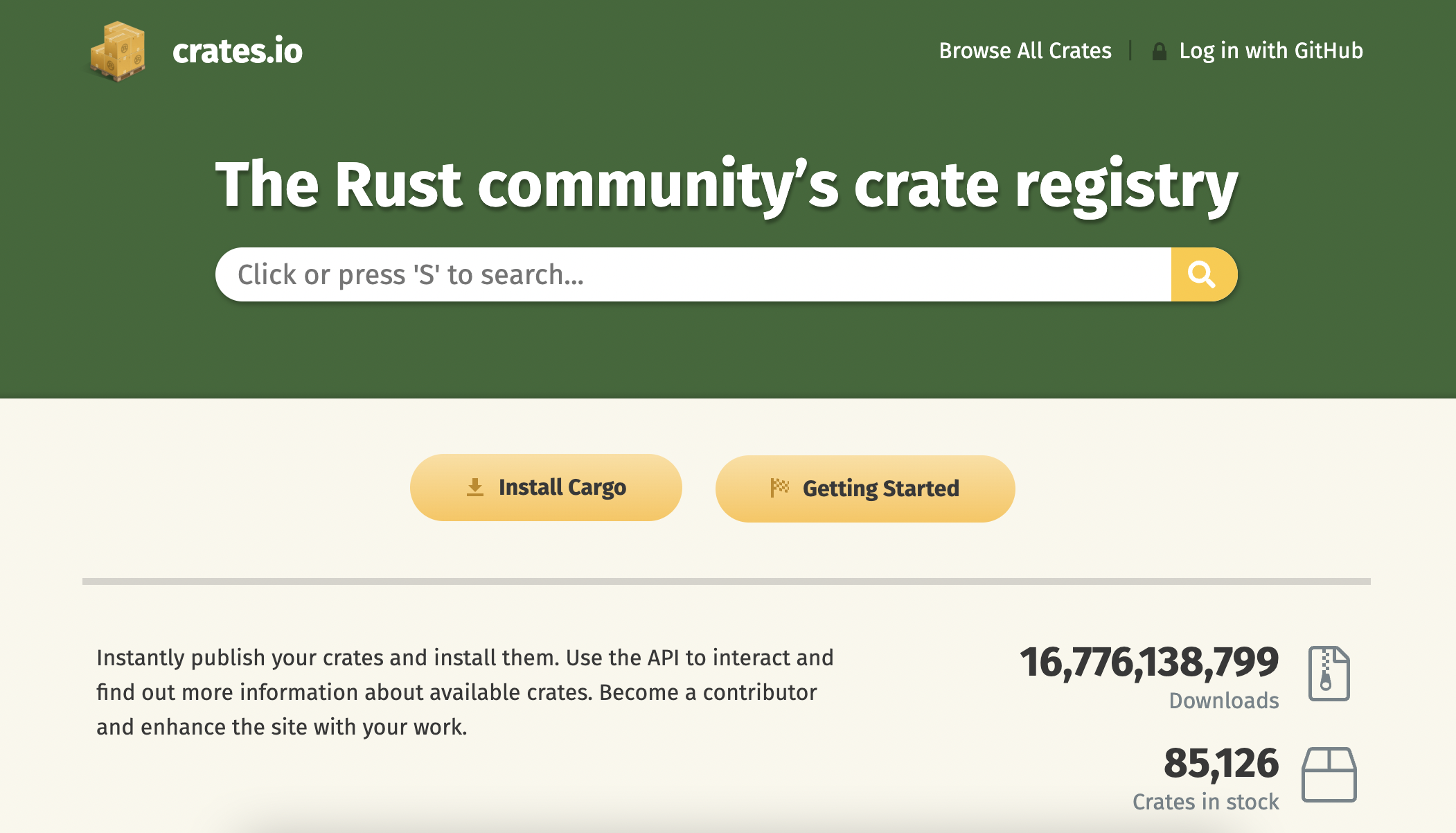
Image: File:Crates.io website.png — Caleb Stanford (CC BY-SA 4.0), via Wikimedia Commons
The Production Toolchain: What to Use in 2026
For teams evaluating Rust + Wasm for production, here is the current standard toolchain:
- wasm-pack — compiles Rust to Wasm and packages it for npm; handles JavaScript glue code generation via wasm-bindgen
- wasm-bindgen — provides type-safe bindings between Rust and JavaScript, allowing complex types (strings, closures, DOM objects) to cross the Wasm boundary
- wasm-opt (from Binaryen) — post-compilation optimizer that typically reduces binary size by 20–30%
- Wasmtime — the leading server-side Wasm runtime, used in production at Fastly; supports WASI and the Component Model specification
- cargo component — the emerging standard for building Wasm components, enabling composable Wasm modules that interoperate across languages
For browser targets, a typical production workflow: write core logic in Rust → compile with wasm-pack build --target web → import the generated npm package into your TypeScript or JavaScript frontend. The Rust code handles performance-critical paths; JavaScript handles DOM interaction and browser APIs.
Frequently Asked Questions
Do I need to know Rust to use WebAssembly in production?
Not necessarily — C, C++, Go, and AssemblyScript all compile to Wasm. However, for production deployments where memory safety and binary size are priorities, Rust is the strongest choice. The learning curve for Rust is real but manageable, and the productivity gained from eliminating entire bug classes in deployed Wasm modules typically pays back the investment within a few months on most engineering teams.
How does WebAssembly's cold start compare to containers?
Wasm cold starts are measured in microseconds to low milliseconds, compared to tens of milliseconds for containers and hundreds of milliseconds for traditional VM-based functions. This is one of Wasm's definitive advantages for edge computing — Cloudflare Workers cites cold starts under 1ms. This performance comes from Wasm's precompiled binary format, which eliminates the need for just-in-time compilation on startup that containers require.
Is WebAssembly mature enough for production backends in 2026?
For edge functions, plugin systems, and compute-intensive browser workloads, yes — Wasm is production-proven at scale. For general-purpose backend services, the picture is more nuanced: WASI is still maturing, the Component Model spec is stabilizing, and debugging tooling lags behind native runtimes. Teams running greenfield edge services or sandboxed plugin architectures will find Wasm + Rust a compelling fit today; teams migrating existing microservices should benchmark carefully before committing fully.
Bottom Line
Rust and WebAssembly together represent one of the most technically sound stacks available for building secure, portable, high-performance production systems in 2026. Rust's compile-time memory safety directly addresses the memory vulnerability classes that the 2024 arXiv security review identified as the primary risk when running C/C++ code in Wasm. For edge serverless functions, browser performance-critical modules, and sandboxed plugin architectures, we recommend this combination as the current state of the art. The tooling has reached production maturity, the ecosystem is deep, and the security fundamentals are genuinely strong. Start with a bounded use case — one edge function or one compute-heavy browser feature — and the architecture's advantages become immediately apparent.
Sources & References:
Perrone, G. & Romano, S.P. — "WebAssembly and Security: a review" — arXiv:2407.12297 (2024)
Disclaimer: This article is for informational purposes only. Technology landscapes change rapidly; verify information with official sources before making technical decisions.