
A 2026 paper introducing RustCompCert — a formally verified compiler for a sequential subset of Rust — underscores what makes Rust unusual among systems languages: its correctness guarantees are not just conventional wisdom, they are now being formally proved at the compiler level (arxiv:2602.07455, 2026). An earlier survey summarizing Rust's design philosophy establishes the foundational tradeoff: ownership and borrowing eliminate memory safety errors that historically consumed 60–70% of critical security fixes in C/C++ codebases, at compile time and with zero runtime overhead (arxiv:2206.05503, 2022). Understanding how to leverage these properties — rather than fight them — is the dividing line between struggling with Rust and writing production-quality systems code in it.
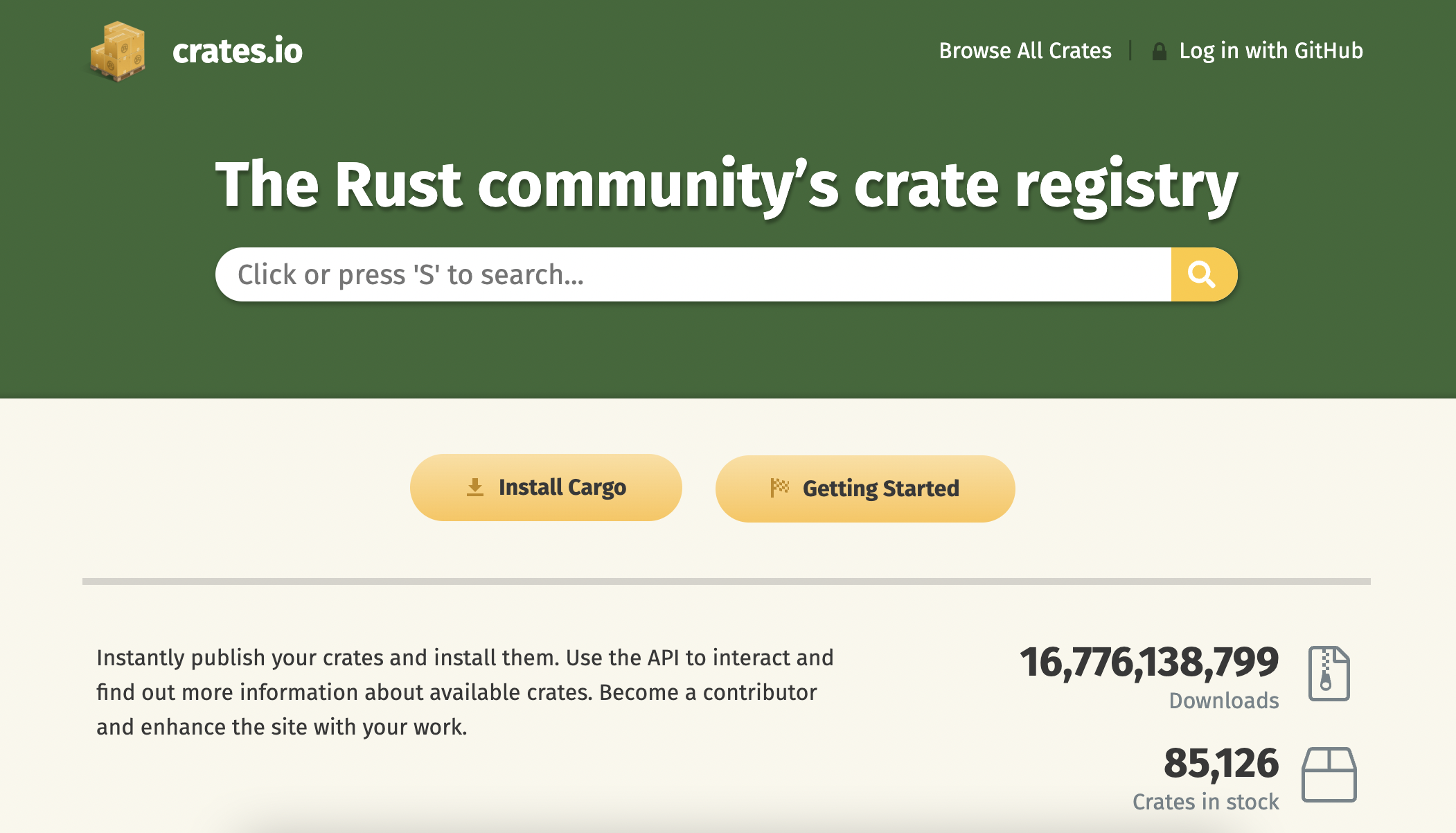
Image: Crates.io website — Caleb Stanford (CC BY-SA 4.0), via Wikimedia Commons
Master Ownership Before Reaching for Rc or Arc
The single most common antipattern in Rust codebases — especially from developers coming from garbage-collected languages — is reflexively wrapping data in Arc<Mutex<T>> to satisfy the borrow checker. This works, but it discards the primary benefit of Rust's ownership model: statically guaranteed, lock-free aliasing rules.
Before introducing shared ownership, exhaust the single-owner design. Reshape your data flow so one clear owner exists, passing references (&T or &mut T) to functions that need temporary access. Most programs that initially seem to require shared state can be restructured around ownership transfer. Arc and Mutex are correct tools for genuinely concurrent shared state — not a default escape hatch from compiler errors.
The compiler's borrow checker error messages in Rust (as of 2024–2026 editions) are unusually actionable. When the compiler rejects your code, read the suggestion carefully. It frequently proposes the correct restructuring. Treating these as blockers rather than guidance is the most common time-sink for Rust newcomers.
Error Handling: Use ? Consistently, Avoid .unwrap() in Library Code
Rust's Result<T, E> and Option<T> types make errors first-class values. The ? operator propagates them ergonomically. The best practice distinction:
- In application code:
.unwrap()or.expect("descriptive message")is acceptable when you can guarantee the value is present and panic is an appropriate failure mode (e.g., program startup, developer assertions). - In library code: Never
.unwrap(). ReturnResultorOptionand let the caller decide. Every.unwrap()in a library is a potential panic you've pushed onto your users without giving them a choice. - Custom error types: For any non-trivial project, define a unified
Errorenum and implementstd::error::Error. Thethiserrorcrate eliminates the boilerplate. Useanyhowfor application-level error aggregation where you care about display but not programmatic matching.
unwrap() — produces significantly more resilient software and is the clearest signal of idiomatic Rust.Iterators and Closures: Zero-Cost Abstractions in Practice
Rust's iterator combinators (.map(), .filter(), .fold(), .flat_map(), .chain()) compile to the same machine code as hand-written loops in virtually all cases. This is the "zero-cost abstraction" guarantee at work. Write expressive iterator chains without hesitating for performance reasons — the compiler optimizes them aggressively.
Prefer iterator chains over explicit for loops when you're transforming or filtering collections. This is more idiomatic and composes better. Use for loops when the body has side effects or complex control flow that doesn't fit a pipeline cleanly.
One common pitfall: collecting unnecessarily. .iter().map(...).collect::<Vec<_>>() allocates a new vector. If you only need to iterate the result once, skip the .collect() and work with the lazy iterator directly. This avoids an unnecessary heap allocation.
Clippy Is Not Optional: It's Your Second Compiler
The Rust project ships cargo clippy, a linter with hundreds of machine-verifiable best practices encoded as lint rules. Running cargo clippy -- -D warnings in CI (treating all warnings as errors) is standard practice in mature Rust projects. Clippy catches:
- Needless clones and allocations
- Manual implementations of standard traits that should use
#[derive] - Incorrect lifetime annotations
- Redundant patterns and match arms
- Panicking code paths that could be avoided
Additionally, run cargo fmt with the default configuration for all code. Rust's formatter is opinionated but consistent. Arguing about formatting is not a productive use of review cycles in a language where the community has converged on a single style.
Managing Dependencies on Crates.io
Rust's ecosystem — 85,000+ crates on crates.io, totaling over 16 billion downloads — is extensive. Effective dependency hygiene matters:
- Audit before adding: Check a crate's recent activity, download count, and open issues. A crate with no commits in two years and an open soundness issue is a liability.
- Use
cargo audit: This tool cross-references your dependency tree against the RustSec advisory database for known vulnerabilities. Run it in CI. - Pin versions carefully: Use exact versions (
=1.2.3) for applications where reproducibility matters. Use caret ranges (^1.2) for libraries to give downstream users flexibility. - Feature flags: Many crates ship optional features. Disable defaults and only enable what you need. This reduces compile times and binary size.
cargo tree --featureshelps audit what's being pulled in.
| Practice | Tool / Crate | What It Prevents | CI Enforced? |
|---|---|---|---|
| Lint enforcement | cargo clippy -D warnings |
Antipatterns, needless allocations | Yes — recommended |
| Format consistency | cargo fmt --check |
Style drift, review noise | Yes — recommended |
| Vulnerability scanning | cargo audit |
Known CVEs in dependencies | Yes — recommended |
| Undefined behavior | cargo miri |
UB in unsafe blocks |
For crates using unsafe |
| Fuzz testing | cargo fuzz / libfuzzer |
Input-triggered panics | For parsers and protocol code |
Writing Testable Rust: Unit Tests in the Source File
Rust's convention of embedding unit tests in the same file as the code they test, inside a #[cfg(test)] mod tests { ... } block, is not just idiomatic — it's practical. Tests live adjacent to the code they verify and are compiled out of production builds automatically.
For integration tests, use the tests/ directory at the crate root. These test the public API from the outside, catching regressions in your crate's contract rather than its internals.
Use cargo test --doc to verify that examples in doc comments actually compile and run. Documentation examples that become stale are a common issue in long-lived libraries; this catches them automatically.
Frequently Asked Questions
When is it acceptable to use unsafe in Rust?
unsafe is appropriate in three narrow situations: implementing low-level abstractions (custom allocators, FFI boundary code), calling C APIs through Rust's FFI, and specific performance-critical paths where the safe abstraction overhead is measurable and significant. Every unsafe block should have a comment explaining the invariant that makes it sound. Run cargo miri on crates with unsafe blocks to catch undefined behavior that the standard compiler would miss. Do not use unsafe to silence borrow checker errors you don't understand — fix the ownership design instead.
How should I structure a large Rust project?
Use Cargo workspaces to split a large project into multiple crates. Each crate should have a clear, narrow responsibility. This improves incremental compile times dramatically because unchanged crates are not recompiled. A common pattern: a core library crate with no I/O, a separate I/O layer crate, and a thin binary crate that wires them together. This separation also makes the core logic independently testable and reusable.
What's the Rust edition I should target in 2026?
Rust 2021 is the current stable edition and what new projects should target in 2026. Rust 2024 was stabilized in late 2024 and brings ergonomic improvements to closures and async lifetimes — it is safe to adopt for new projects and worth migrating to for active ones. Editions are backward-compatible within a workspace; you can mix crates targeting different editions. Run cargo fix --edition to automate most of the migration work.
Bottom Line
Rust's learning curve is real, but its productivity payoff is concentrated in the areas that cost the most in other systems languages: memory bugs, data races, and undefined behavior that manifests only in production. We recommend treating Clippy as a first-class part of your toolchain from day one, investing in understanding ownership before reaching for shared references, and using the Rust 2021 or 2024 edition for all new projects. The research establishing Rust's safety model is now supported by formal verification work — writing idiomatic Rust is not just good practice, it is increasingly mathematically justified.
Sources & References:
Rust: The Programming Language for Safety and Performance. arXiv:2206.05503 (2022).
RustCompCert: A Verified and Verifying Compiler for a Sequential Subset of Rust. arXiv:2602.07455 (2026).
Disclaimer: This article is for informational purposes only. Technology landscapes change rapidly; verify information with official sources before making technical decisions.