
Every time a pod is scheduled on Kubernetes, a value is written to etcd. Every time Consul elects a leader, or CockroachDB commits a transaction, or TiKV replicates a key—Raft is doing the work underneath. A January 2026 vulnerability assessment (arXiv:2601.00273) by Afifi et al. opens with a blunt statement: Raft is now "a main pillar of the distributed systems ecosystem." At the same time, active research continues to push its boundaries: Wang et al.'s CD-Raft (arXiv:2603.10555, March 2026) demonstrates that the classic algorithm can be significantly improved for cross-domain deployments, achieving 32.90% average latency reduction and 49.24% tail latency reduction over standard Raft. Understanding Raft—how it works, where it can fail, and how modern optimizations extend it—is now table-stakes knowledge for any engineer working on reliable backend infrastructure.
The Problem Raft Was Designed to Solve
Distributed consensus is the challenge of getting a cluster of nodes to agree on a sequence of values even when some nodes crash, network links drop packets, or messages arrive out of order. The classic solution was Paxos, introduced by Leslie Lamport in 1989. Paxos is theoretically sound but notoriously difficult to understand and, more critically, to implement correctly. Nearly every team that has tried to build on "vanilla" Paxos has discovered that the algorithm as described in the original paper leaves enormous implementation gaps—gaps that become bugs in production.
Diego Ongaro set out to fix this with Raft, introduced in his 2014 dissertation and paper "In Search of an Understandable Consensus Algorithm." His design principle was explicit: understandability over cleverness. Where Paxos allows multiple concurrent proposals and requires complex reconciliation, Raft enforces a single strong leader at all times. Where Paxos requires significant additional engineering to handle log compaction, cluster membership changes, and client interaction, Raft's original paper addresses each of these directly. The result is an algorithm that practicing engineers can read, understand, and implement correctly—which is exactly why it now underpins so much critical infrastructure.
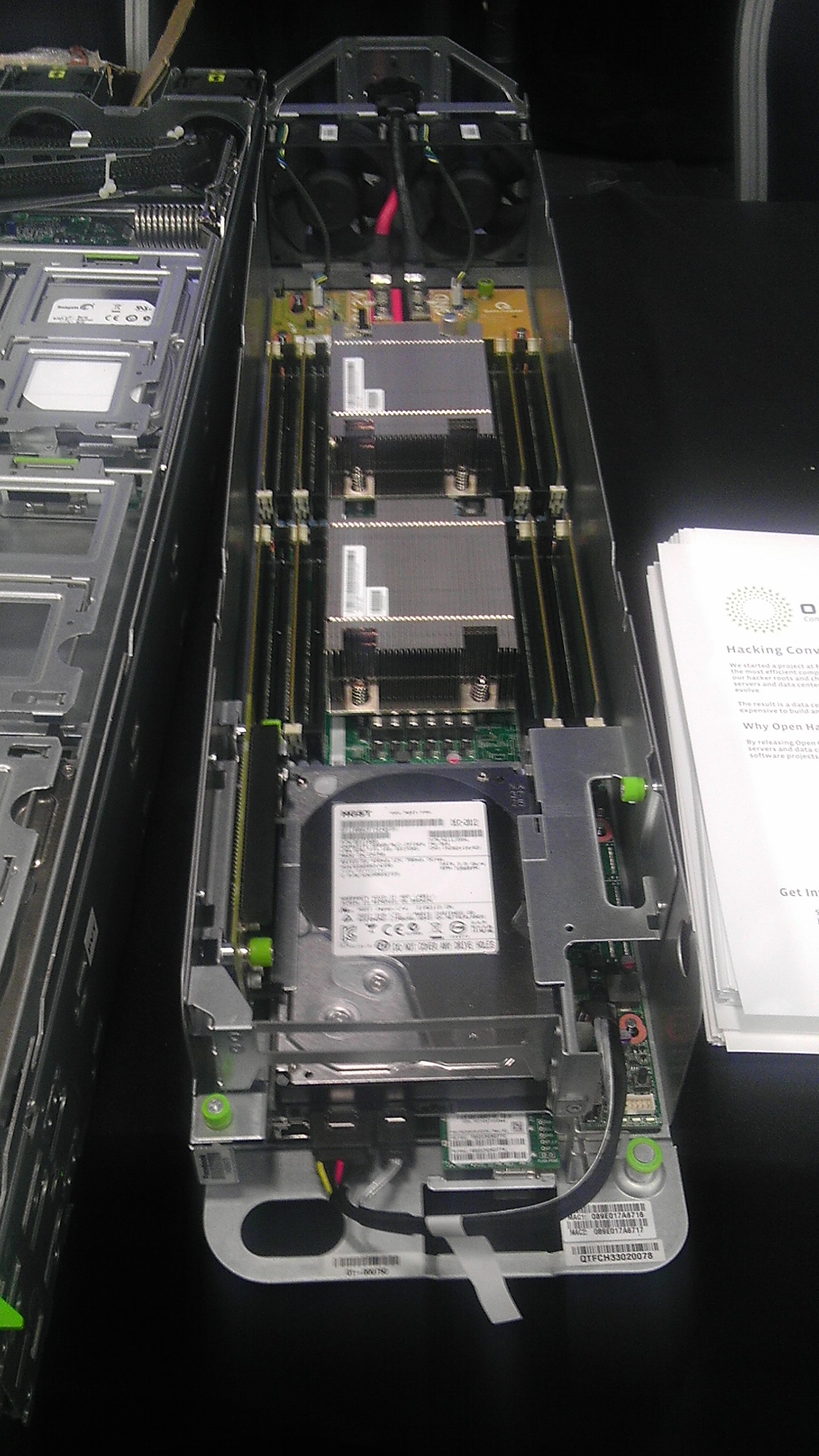
Image: Open Compute Server Front.jpg — Robert.Harker (CC BY-SA 3.0), via Wikimedia Commons
How Raft Works: Three Core Mechanisms
Raft decomposes the consensus problem into three largely independent subproblems, which makes the algorithm much easier to reason about than Paxos.
(a) Leader Election
Every node in a Raft cluster starts as a follower. Followers expect to receive periodic heartbeats from a leader. If a follower goes too long without a heartbeat—the election timeout, typically randomized between 150ms and 300ms—it transitions to candidate state, increments its term number, and requests votes from peers. A candidate wins the election if it receives votes from a majority of the cluster (more than half). Term numbers are Raft's mechanism for preventing split-brain: any message from a previous term is immediately rejected. Once elected, the leader sends heartbeats to reset all followers' election timers, suppressing spurious elections. The randomized election timeout is a simple but elegant trick: it dramatically reduces the chance that two nodes become candidates at exactly the same time and split the vote.
(b) Log Replication
The leader accepts all client writes. When a client submits a command, the leader appends it to its own log as a new entry, then sends AppendEntries RPCs to every follower in parallel. An entry is considered committed only once the leader has received acknowledgment from a majority of nodes (including itself). Only after commitment does the leader apply the entry to its state machine and respond to the client. Followers apply committed entries in order, ensuring every node in the cluster converges to the same state. If a follower is slow or temporarily unreachable, the leader retries indefinitely—Raft's log replication is inherently idempotent.
(c) Safety
Raft's safety guarantee is the hardest part to get right: no committed entry is ever lost. This is enforced through the vote restriction. A candidate can only receive a vote from a follower if the candidate's log is at least as up-to-date as the follower's log (compared first by term, then by index). This means any candidate that wins a majority election necessarily has all committed entries—because the majority that voted for it overlaps with the majority that originally acknowledged each committed entry. This single constraint, enforced during voting, provides the algorithm's core safety property without any additional coordination.
Modern Raft Optimizations for Production
Classic Raft performs well in single-datacenter deployments but shows its limitations when nodes span geographic regions. Two recent papers from 2026 illustrate where the state of the art is heading.
CD-Raft (Wang et al., arXiv:2603.10555) targets cross-domain consensus—clusters where nodes are spread across different administrative domains or geographic sites. The key insight is that standard Raft's commit path requires two sequential round trips: the leader sends AppendEntries, waits for majority acknowledgment, then applies and responds. In a cross-region cluster, each round trip adds tens to hundreds of milliseconds of RTT. CD-Raft restructures the replication pipeline to overlap these phases and optimizes leader placement relative to the majority of replicas. The results are significant: 32.90% average latency reduction and 49.24% tail latency reduction compared to classic Raft, without sacrificing correctness or fault tolerance.
Nezha (Wang et al., arXiv:2603.09122), presented at ICDE 2026, takes a different angle. Traditional key-value stores on top of Raft write both keys and values through the consensus log, which is expensive for large values. Nezha integrates key-value separation directly into the Raft layer—only keys and metadata go through consensus, while values are written to a separate value store. This dramatically reduces the size of log entries that need majority replication. The result: 460.2% throughput improvement on write-heavy workloads compared to conventional Raft-backed stores. Nezha demonstrates that the basic Raft protocol can be extended with storage-aware optimizations without breaking its safety guarantees.
| Approach | Understandability | Fault Tolerance | Performance | Best For |
|---|---|---|---|---|
| Raft | High | f = (n-1)/2 | Good | General-purpose systems |
| Paxos | Low | f = (n-1)/2 | Good | Academic reference / legacy |
| Multi-Paxos | Medium | f = (n-1)/2 | Better | Large-scale writes |
| Zab | Medium | f = (n-1)/2 | Good | ZooKeeper-specific |
| Viewstamped Replication | Medium | f = (n-1)/2 | Good | Research contexts |
Security Considerations You Can't Ignore
Standard Raft specifications focus entirely on crash fault tolerance—nodes that fail by stopping. They assume the network is secure and messages come from legitimate cluster members. This assumption breaks down in real deployments, and a 2026 paper makes the risks concrete.
Afifi et al. (arXiv:2601.00273) conducted a systematic vulnerability assessment of standard Raft implementations and identified two classes of attack that are particularly dangerous. Message replay attacks involve an adversary capturing legitimate Raft messages (such as RequestVote or AppendEntries RPCs) and retransmitting them later to manipulate cluster state—forcing unnecessary elections or causing nodes to accept stale log entries. Message forgery attacks involve an adversary injecting crafted Raft messages to impersonate the leader or a legitimate voter, potentially overwriting committed log entries or disrupting quorum.
The paper proposes two mitigations that production teams should treat as non-negotiable: authenticated message verification (every Raft RPC must be signed and its signature verified before processing) and freshness checks (nonces or timestamps must be included in RPCs to detect and reject replayed messages). In practice, this translates to: deploy Raft over TLS mutual authentication so every node verifies the identity of its peers, and use signed RPC calls at the application layer if your Raft library does not enforce this by default. etcd, Consul, and CockroachDB all support mutual TLS for peer communication—enable it, always, even in internal network deployments.
Production Deployment Patterns
Knowing the theory is not enough. Here are the patterns that separate reliable Raft deployments from ones that page you at 3am.
Cluster size: Always deploy 3 or 5 nodes. A 3-node cluster tolerates 1 failure; a 5-node cluster tolerates 2 failures. Even-numbered cluster sizes are wasteful—a 4-node cluster still only tolerates 1 failure (because majority is 3), giving you no additional fault tolerance over 3 nodes at higher cost. Never run a 2-node Raft cluster in production; it cannot tolerate any failure.
Leader lease reads: By default, a Raft leader must contact a majority before serving a linearizable read, adding a round trip per read. Leader leases—where the leader assumes it is still the leader for a bounded time window after its last successful heartbeat round—allow reads to be served locally without a quorum round trip. Most production Raft implementations (etcd, TiKV) support this optimization. Understand the clock skew implications before enabling it.
Pre-vote phase: A node that is temporarily partitioned from the cluster will increment its term and issue vote requests when it reconnects, disrupting the current leader even though the cluster was healthy. The pre-vote extension (now standard in etcd) requires a node to first confirm it would win an election before incrementing its term, eliminating this disruption.
Joint consensus for membership changes: Adding or removing nodes from a running Raft cluster is dangerous if done naively. Raft's joint consensus approach transitions the cluster through an intermediate configuration that requires agreement from both the old and new majority, preventing split elections during the transition. Use it; do not roll your own membership change logic.
What to monitor: Track election frequency (more than one election per hour in a stable cluster is a warning sign), replication lag per follower (sustained lag indicates a slow or overloaded node), and commit latency (the time from client write to committed acknowledgment). Alert on these metrics; they are your earliest warning of consensus health problems.
Frequently Asked Questions
Why use 3 or 5 nodes instead of 2 or 4?
Raft requires a majority—more than half—of nodes to make progress. With 2 nodes, losing 1 means you can no longer form a majority and the cluster halts. With 4 nodes, a majority is 3, so you can only tolerate 1 failure—identical fault tolerance to a 3-node cluster, but with higher cost and more complexity. The practical guidance is simple: odd-numbered clusters of 3 or 5 give you the best fault-tolerance-to-cost ratio. A 4-node cluster tolerates only 1 failure, the same as 3 nodes, so even-numbered sizes waste a node without improving resilience. Beyond 5 nodes, the commit latency penalty from waiting on a larger majority usually outweighs the marginal improvement in fault tolerance.
What happens when the Raft leader crashes?
Followers detect the crash by timing out on heartbeats. After the election timeout (typically 150–300ms in a LAN deployment), one or more followers become candidates and trigger an election. A new leader is elected—within one election timeout in the best case, within a few timeouts if there is a vote split. In-flight writes that the crashed leader had not yet committed are safely handled: the new leader will not have them in its log (since they were not acknowledged by a majority), and clients will retry. Writes that were committed but not yet applied to the state machine will be present in the new leader's log and will be applied normally. From a client perspective, committed writes are never lost; uncommitted writes are safely retried.
Is Raft suitable for geographically distributed systems?
Standard Raft adds cross-region RTT directly to write commit latency, since the leader must wait for a majority of followers to acknowledge each entry before responding to the client. In a cluster spread across three regions with 100ms inter-region RTT, every write takes at least 100ms. This is often acceptable—many systems tolerate 100–200ms write latency. When it is not, CD-Raft (arXiv:2603.10555) demonstrates that algorithmic optimizations—pipelining, leader placement, and round-trip overlap—can recover 32.90% of that latency without sacrificing correctness. Multi-region Raft is viable but requires careful tuning of election timeouts (set them much longer than cross-region RTT to avoid spurious elections) and deliberate leader placement (co-locate the leader with the region that generates the most writes).
Bottom Line
Raft is the right consensus algorithm for teams building reliable distributed systems who want strong correctness guarantees without Paxos's notorious implementation complexity. Its clear decomposition into leader election, log replication, and safety constraints maps directly to the failure modes you will encounter in production. The practical checklist is short: deploy 3 or 5 nodes, enable TLS mutual authentication between peers and sign your RPCs (the 2026 vulnerability research from Afifi et al. makes the stakes of skipping this clear), monitor election frequency and commit latency, and use joint consensus for any membership changes. When you need to go multi-region, the CD-Raft research shows the path forward. The battle-tested implementations—etcd backing Kubernetes, Consul for service mesh coordination, CockroachDB and TiKV for distributed SQL and key-value storage—exist because Raft is an algorithm that real teams can implement, operate, and trust.
Sources & References:
Wang Y et al. (2026). CD-Raft: Reducing the Latency of Distributed Consensus in Cross-Domain Sites. arXiv:2603.10555.
Wang Y et al. (2026). Nezha: A Key-Value Separated Distributed Store with Optimized Raft Integration. ICDE 2026. arXiv:2603.09122.
Afifi T et al. (2026). From Consensus to Chaos: A Vulnerability Assessment of the RAFT Algorithm. IJACSA 16(12). arXiv:2601.00273.
Disclaimer: This article is for informational purposes only. Technology landscapes change rapidly; verify information with official sources before making technical decisions.