
Modern applications are API-first, which means the attack surface has shifted dramatically. A decade ago, most exploits targeted web interfaces. Today, the API layer — the interface that connects mobile apps, third-party integrations, and microservices — is the primary entry point for attackers. The Open Web Application Security Project (OWASP) maintains an API Security Top 10 list specifically because the failure modes of APIs differ enough from traditional web application vulnerabilities to require their own framework. The core challenge is that REST APIs are often deployed with the assumption that only authorized clients will call them — in practice, any endpoint reachable over a network is reachable by anyone.
The Non-Negotiable Foundation: TLS for All Endpoints
The most fundamental security control is enforcing Transport Layer Security (TLS). Every REST API in production must be served exclusively over HTTPS, without exception. Without TLS, all tokens, API keys, and request bodies travel in plaintext and are trivially interceptable by anyone on the same network — a classic man-in-the-middle attack.

Image: What is HTTPS — (Public domain), via Wikimedia Commons
Even if your API is internal to a private network, lateral movement within a compromised environment means internal traffic must be treated as potentially hostile. The operational argument for skipping TLS on internal services has largely collapsed — certificate automation (Let's Encrypt, AWS ACM) eliminates the management burden that made TLS burdensome a decade ago.
Implementation checklist:
- Redirect all HTTP traffic to HTTPS at the load balancer or gateway level — do not rely on application code to do this consistently
- Set the
Strict-Transport-Security: max-age=63072000; includeSubDomains; preloadresponse header - Disable TLS 1.0 and TLS 1.1; require TLS 1.2 minimum, with TLS 1.3 preferred
- Automate certificate renewal to prevent unexpected expiration outages
Authentication: Matching the Mechanism to the Trust Model
Authentication answers "who are you?" — and the right mechanism depends on your client profile and trust model.
OAuth 2.0 with JWT tokens is the industry standard for user-facing APIs that need to grant delegated access. Access tokens are short-lived (15 minutes to 1 hour). Refresh tokens allow renewal without re-authentication. The JWT payload carries scopes and claims that the server validates on each request — without a database lookup for every call, because the token is cryptographically signed. Always validate the algorithm explicitly in your JWT library; the alg: none vulnerability has compromised production systems that trusted client-supplied algorithm fields.
API keys remain appropriate for machine-to-machine authentication where a fixed service identity calls your API. API keys should be at least 256 bits of entropy (32+ random bytes, hex or base64 encoded), stored as a SHA-256 hash in your database (never plaintext), scoped to specific operations, and support rotation without requiring client downtime.
Mutual TLS (mTLS) is the strongest option for internal microservice-to-microservice communication. Both the client and server present certificates, and the server verifies the client's identity before accepting the connection. More operationally complex, but appropriate for high-security service meshes following zero-trust principles.
Authorization: Object-Level Checks on Every Data Access
Authentication and authorization are separate concerns, and confusing them is the root cause of Broken Object Level Authorization (BOLA) — the OWASP API Security Top 10's number-one category. BOLA occurs when an API validates that a user is authenticated but fails to verify that the authenticated user is allowed to access the specific resource they're requesting.
The classic vulnerable pattern:
GET /api/accounts/1234/transactionsIf your API returns these transactions for any authenticated user — not just the user whose account ID is 1234 — you have a BOLA vulnerability. The fix: always fetch the resource owner from your authorization context (the token's subject claim or session), then compare it to the resource owner in the database. Never trust the client-supplied ID as an authorization proof.
Role-Based Access Control (RBAC) or Attribute-Based Access Control (ABAC) should govern which operations each token scope permits. Define scopes minimally: a read-only token (accounts:read) should fail with HTTP 403 on any write endpoint.
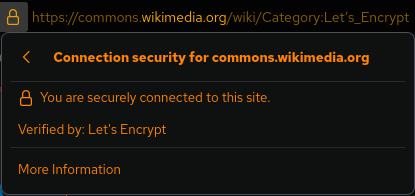
Image: HTTPS on Firefox 89 screenshot — Mozilla Firefox (MPL 2.0), via Wikimedia Commons
Input Validation and Injection Prevention
REST APIs must treat every incoming request — body, query parameter, header value, and path segment — as untrusted. The minimum required validation at each endpoint:
- Schema validation: Reject requests that don't conform to the expected structure before processing begins. Libraries like Zod (TypeScript), Pydantic (Python), or JSON Schema validators enforce this at the boundary.
- Type checking: A field declared as integer should raise an HTTP 400 error if the client sends a string.
- Size limits: Set maximum lengths on string fields and enforce maximum body size at the gateway to prevent memory exhaustion and denial-of-service.
- Mass assignment prevention: Never pass the raw request body directly to your ORM's create or update methods. Explicitly allowlist the fields your endpoint accepts.
- Parameterized queries: Use parameterized queries or ORM abstractions for every database interaction. Interpolating request parameters directly into SQL or NoSQL queries is the root cause of injection attacks.
HTTP 400 (Bad Request) is the correct response when validation fails. Return enough detail for a legitimate client to correct their request, but never expose internal schema, table names, or stack traces in error responses.
Rate Limiting, Throttling, and Abuse Prevention
Every production API needs rate limiting at multiple layers. Without it, a single malicious client can exhaust compute capacity, enable credential stuffing at scale, or drive your database to its limits through unbounded query loops.
| Layer | Control | Priority | Common Gap |
|---|---|---|---|
| Transport | TLS 1.2+ + HSTS header | Critical | HTTP allowed on internal routes |
| Authentication | OAuth 2.0 + short-lived JWTs | Critical | Long-lived tokens, no rotation |
| Authorization | RBAC + object-level ownership checks | Critical | BOLA — missing per-resource ownership check |
| Input | Schema validation + parameterized queries | High | Mass assignment, accepting extra fields |
| Rate limiting | Per-client + per-endpoint limits | High | No limits on authentication endpoints |
| Response | Minimal data exposure + security headers | Medium | Leaking server internals in error messages |
Implement rate limiting at the API gateway level (Kong, AWS API Gateway, NGINX) rather than within each individual service — this ensures consistent enforcement regardless of which service handles the request. Authentication endpoints (login, token refresh, password reset) warrant tighter limits than read-only data endpoints. Return 429 Too Many Requests with a Retry-After header to signal when the client may retry.
Response Security and Data Minimization
What your API returns is as important as what it accepts. The OWASP API Top 10 includes "Excessive Data Exposure" as a separate category: APIs that return full object representations and rely on the client to filter sensitive fields are fundamentally insecure. Your API should:
- Return only the fields the requesting client's role and scope are entitled to see — not the full database row
- Never return internal identifiers, stack traces, or exception messages in production error responses
- Set
Cache-Control: no-storeon responses containing sensitive data to prevent caching by intermediaries - Include
X-Content-Type-Options: nosniffand removeServer:andX-Powered-By:headers, which provide reconnaissance information at no cost to attackers
Frequently Asked Questions
Should internal APIs behind a VPN skip TLS?
No. Internal APIs should also use TLS. A network perimeter is not a reliable security boundary — once an attacker gains access to the internal network (which is an assumed scenario in zero-trust architectures), all unencrypted traffic becomes readable. The operational cost of TLS on internal services has dropped to near zero with modern certificate automation tools, and the security benefit is too significant to skip.
How do I securely store API keys server-side?
Never store API keys in plaintext in your database. Store a SHA-256 hash of the key and compare the hash of each incoming key against the stored hash. This way, even if your database is compromised, the raw keys are not exposed. The key itself is generated with cryptographic randomness (at least 256 bits), shown to the user exactly once at creation, and impossible to recover — only replaceable. Prefix the key with a recognizable string (e.g., sk_live_) to make it identifiable in logs and secret scanners without exposing its value.
What security headers should every REST API return?
At minimum: Strict-Transport-Security (enforces HTTPS), X-Content-Type-Options: nosniff (prevents MIME-type sniffing), and Cache-Control: no-store for sensitive responses. Remove informational headers like Server: and X-Powered-By:. For APIs that serve responses to browsers, also configure a Content-Security-Policy. Regularly review your response headers against a tool like SecurityHeaders.com to catch regressions after framework upgrades.
Bottom Line
Securing REST API endpoints requires layered controls applied consistently — there is no single header, library, or service that substitutes for systematic implementation. We recommend starting with the non-negotiable foundation: TLS everywhere, short-lived tokens, and object-level authorization checks on every resource access. Then layer in input schema validation and rate limiting at the gateway. Validate your implementation against the OWASP API Security Top 10 before going to production, and re-test after any significant architectural change. Security is not a one-time configuration; it requires the same ongoing investment as reliability and performance.
Sources & References:
OWASP API Security Project — API Security Top 10 (owasp.org)
RFC 6749 — The OAuth 2.0 Authorization Framework (IETF)
RFC 7519 — JSON Web Token (JWT) Standard (IETF)
Disclaimer: This article is for informational purposes only. Technology landscapes change rapidly; verify information with official sources before making technical decisions.