
Security can no longer be an afterthought bolted onto the end of a development cycle. With breach costs averaging millions of dollars and regulatory pressure intensifying globally, organizations that treat security as a phase rather than a practice are falling behind — and falling victim. DevSecOps integrates security throughout the entire software development lifecycle, and in 2026, it's the standard for any serious engineering organization.
What DevSecOps Actually Means
DevSecOps extends the DevOps philosophy — fast, iterative delivery with shared ownership — to include security. Instead of a security team reviewing code only before release, security is everyone's responsibility, embedded into every stage: planning, coding, building, testing, deploying, and monitoring.
The practical shift: security controls become automated, developers get security feedback in their IDE and in pull requests rather than weeks later, and security teams shift from gatekeepers to enablers who build the tooling and standards that development teams use.

Phase 1: Secure the Development Environment
Start at the developer's workstation. Integrate security tooling into the IDE with plugins that flag OWASP Top 10 vulnerabilities as code is written. Implement pre-commit hooks that run secret scanning (tools like git-secrets, truffleHog) to prevent credentials from ever reaching the repository. Enforce code signing and require signed commits so you have an audit trail of who changed what.
Phase 2: Shift Left in CI/CD
The CI pipeline is your primary security enforcement layer. Integrate these categories of scanning:
- SAST (Static Application Security Testing) — Analyze source code for vulnerabilities without running it. Tools: SonarQube, Semgrep, Checkmarx.
- SCA (Software Composition Analysis) — Scan dependencies for known CVEs. Tools: Snyk, OWASP Dependency-Check, GitHub Dependabot.
- Secret Scanning — Detect hardcoded credentials and API keys. GitHub Advanced Security and GitGuardian are popular choices.
- IaC Scanning — Scan Terraform, CloudFormation, and Kubernetes manifests for misconfigurations. Tools: Checkov, tfsec, Trivy.
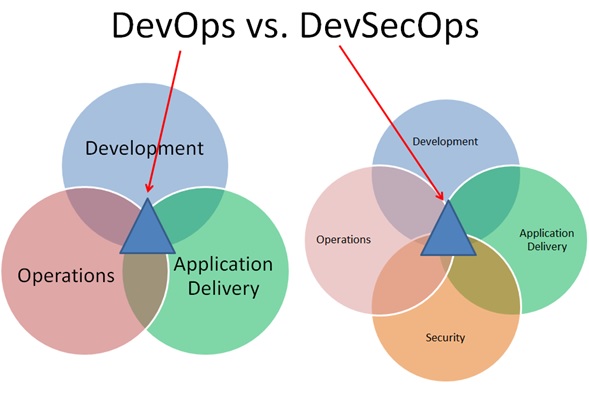
Image: DevOps vs DevSecOps Mginise — Mginise (CC BY-SA 4.0), via Wikimedia Commons
Phase 3: Runtime Security and Monitoring
Security doesn't end at deployment. Implement runtime application self-protection (RASP) and continuous monitoring. Use a SIEM (Security Information and Event Management) system to aggregate logs and alert on anomalies. Implement DAST (Dynamic Application Security Testing) against running applications. Conduct regular penetration testing — at minimum annually, ideally quarterly for critical systems.
Phase 4: Building Security Culture
Tools without culture fail. Run security champions programs where engineers from each team receive deeper security training and serve as liaisons to the security team. Conduct blameless post-mortems on security incidents. Make threat modeling a standard part of design reviews. Gamify security with bug bounty programs and internal CTF competitions.
The Bottom Line
Implementing DevSecOps is a journey, not a project. Start by automating secret scanning and dependency vulnerability checks in your CI pipeline — these have the highest ROI and lowest friction. Then expand to SAST, IaC scanning, and runtime monitoring. The goal is making secure behavior the path of least resistance for developers, so security becomes automatic rather than adversarial.
Sources & References:
NIST — Secure Software Development Framework (SSDF), 2024
OWASP — DevSecOps Guideline, 2025
Gartner — DevSecOps Market Guide, 2025
CISA — Known Exploited Vulnerabilities Catalog, 2026
Disclaimer: This article is for informational purposes only. Technology landscapes change rapidly; verify information with official sources before making technical decisions.