
A 2026 arXiv paper from networking researchers studying cross-cloud interconnect costs found that organizations routinely overpay for cloud data transfer because they optimize compute costs while overlooking inter-cloud network topology and egress charges — a finding that captures a broader truth: cloud cost optimization is rarely a single-lever problem. The teams that consistently reduce cloud spend by 30–50% attack multiple layers simultaneously and build cost awareness into their engineering culture from day one.
Why Cloud Cost Optimization Is Harder Than It Looks
Cloud platforms are designed to make consumption frictionless. Spinning up infrastructure takes minutes; identifying waste in that infrastructure can take months. The fundamental challenge is that cloud cost problems are distributed across teams, time zones, and business units — with no single person accountable for the full picture.
A 2026 arXiv paper on intelligent cloud orchestration demonstrated that hybrid predictive and heuristic frameworks can reduce cloud resource costs by automatically right-sizing workloads based on historical and real-time utilization patterns — but the paper also noted that most organizations still rely on static resource allocation, leaving substantial savings unrealized.
Most organizations begin optimization reactively — after receiving a surprising bill. The teams that build cost optimization into their engineering culture before bills become a problem see compounding returns over time as cost awareness shapes architectural decisions from the start.
Strategy 1: Right-Size Your Compute Resources
The most immediate source of cloud waste in most organizations is over-provisioned compute. Teams request instances based on peak load projections, then leave them running at 10–20% average CPU utilization. Cloud providers' own utilization studies consistently show median CPU usage well below 50% across customer workloads.
Right-sizing means matching instance type and size to actual workload requirements, not projected maximums. Use your cloud provider's compute optimizer tool (AWS Compute Optimizer, Azure Advisor, or GCP Recommender) to identify instances running below 40% average CPU over the past 30 days. Downsizing or switching to burstable instance families (like AWS T3 or Azure Bsv2) can deliver 30–50% savings on those specific resources.
Important caveat: right-sizing must be validated against memory usage and I/O patterns, not CPU alone. A database instance running at 15% CPU may still be appropriately sized if it is I/O-bound or memory-constrained. Always check all resource dimensions before resizing.
Strategy 2: Commit to Reserved Instances and Savings Plans
On-demand pricing is the most expensive way to run predictable workloads. Reserved instances (RIs) and commitment-based savings plans offer discounts of 30–60% compared to on-demand pricing in exchange for a 1- or 3-year commitment.
The key to purchasing commitments without regret is to analyze your baseline load — the floor of compute consumption that runs continuously regardless of traffic patterns. Commit only to that baseline. Keep peak and unpredictable workloads on spot or on-demand capacity. This layered approach captures the savings of commitment pricing without locking in capacity you don't consistently use.

Image: Wikimedia Foundation Servers-8055 13 — Victorgrigas (CC BY-SA 3.0), via Wikimedia Commons
Strategy 3: Eliminate Idle and Orphaned Resources
Every organization has cloud resources that are running but not serving any active purpose. Common culprits: EBS volumes attached to stopped instances, elastic IP addresses not associated with a running instance, load balancers with no healthy targets, and snapshots accumulating for long-terminated instances.
A regular cloud hygiene process — run monthly or integrated into your CI/CD pipeline — should scan for and flag these resources. Most cloud providers offer tools for this (AWS Trusted Advisor, Azure Cost Management, GCP Active Assist). Third-party tools like Infracost, CloudHealth, or Spot.io offer deeper analysis across multi-cloud environments.
Storage cost is particularly easy to overlook. S3 lifecycle policies, Azure Blob storage tiers, and GCP Object Lifecycle Management allow you to automatically transition infrequently accessed data to cheaper storage classes. Moving data from standard to infrequent-access tiers can reduce storage costs by 40–60% for data that hasn't been accessed in 30+ days.
Strategy 4: Implement Intelligent Auto-Scaling
Static capacity allocation is the enemy of cost efficiency. Auto-scaling — adjusting resource capacity automatically based on real-time demand — is one of the highest-leverage cost strategies available, particularly for variable traffic workloads.
The 2026 arXiv research on intelligent cloud orchestration highlights predictive scaling (scaling before demand arrives, based on historical patterns) as more cost-efficient than purely reactive scaling (scaling in response to current load). Predictive scaling reduces both the cost of over-provisioning during off-peak hours and the performance impact of reactive scaling during traffic spikes.
At minimum, ensure that all stateless compute layers (web servers, API servers, batch processing workers) have auto-scaling configured with appropriately calibrated scale-in and scale-out policies. The right balance usually requires load-testing to identify safe scale-in thresholds.
| Strategy | Typical Savings | Effort Required | Best For |
|---|---|---|---|
| Right-sizing compute | 15–35% | Low–medium | All environments |
| Reserved instances / savings plans | 30–60% | Low | Stable baseline workloads |
| Eliminating idle resources | 5–20% | Low | All environments |
| Auto-scaling | 20–40% | Medium | Variable traffic workloads |
| Data transfer optimization | 10–30% | Medium–high | Multi-cloud / data-heavy workloads |
| Storage tiering | 40–60% on eligible data | Low | Large data stores |
| FinOps culture + tagging | Compounds all others | High (organizational) | Organizations at scale |
Strategy 5: Optimize Data Transfer and Egress Costs
Data transfer costs are consistently underestimated. Moving data between cloud regions, between availability zones, or — most expensively — out to the internet or to another cloud provider can become a significant line item for data-intensive workloads.
A 2026 hands-on measurement study of cross-cloud interconnects (arXiv:2606.01440) found that the cost of moving data between cloud providers varies dramatically depending on the specific interconnect path taken, and that organizations often pay premium data transfer rates when cheaper direct interconnect options exist. The researchers recommend auditing actual data flow paths rather than assuming that the cheapest compute region is also the cheapest option for inter-service communication.
Practical steps: use your cloud provider's cost explorer to identify your top data transfer charges by service and direction. Colocate services that communicate heavily in the same availability zone. Use CDNs to serve static assets, which dramatically reduces origin data transfer. For multi-cloud architectures, evaluate whether direct interconnect products offer better economics than public internet transfer for high-volume data flows.
Strategy 6: Leverage Spot and Preemptible Instances
Cloud providers offer spare capacity at discounts of 60–90% compared to on-demand pricing, in exchange for the possibility of reclamation with short notice. These are called spot instances (AWS), preemptible VMs (GCP), or Azure Spot VMs.
For workloads that are fault-tolerant, stateless, or can be check-pointed — batch data processing, training ML models, rendering pipelines, CI/CD workers, and load-testing environments — spot pricing represents the highest discount available. The engineering cost is handling interruptions gracefully, which typically means stateless design and idempotent job queues. For teams already running containerized, orchestrated workloads, adding spot capacity as a secondary node pool is often achievable with minimal additional engineering.
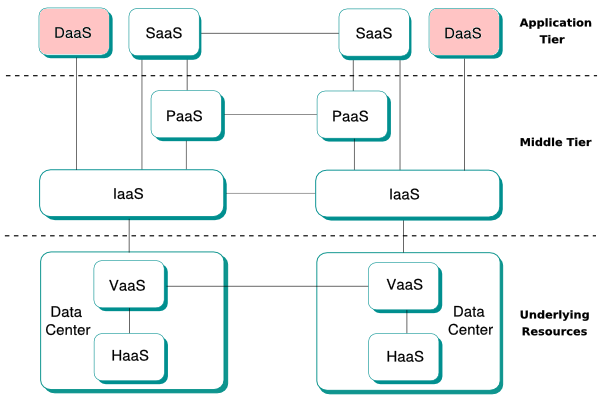
Image: Desktop-as-a-Service in Cloud Computing architectures — Davide Lamanna (CC BY-SA 3.0), via Wikimedia Commons
Strategy 7: Embed FinOps Culture and Cost Tagging
The highest-leverage long-term investment in cloud cost optimization is organizational, not technical. FinOps — the practice of making cloud financial accountability a shared responsibility across engineering, finance, and product teams — consistently delivers better outcomes than centralized cost management by a platform team alone.
The foundation of FinOps is resource tagging. Without consistent, enforced tags (cost center, team, environment, project, service), you cannot allocate cloud costs meaningfully — and without meaningful allocation, no team has a clear incentive to optimize. Establish a tagging taxonomy, enforce it at provisioning time through infrastructure as code and policy-as-code tools, and publish per-team cost dashboards that teams can see and act on.
Beyond tagging, the cultural shift involves making cost a first-class concern in architecture reviews and sprint planning. When developers understand that their infrastructure choices have real financial consequences — and that those costs are visible and attributed — cost-efficient design becomes a natural part of how the team builds.
Frequently Asked Questions
What is the easiest cloud cost optimization win to implement first?
Reserved instances and savings plans offer the largest savings for the least engineering effort. If your organization has workloads that have run predictably for 6+ months, purchasing 1-year reserved capacity for that baseline load typically saves 30–40% immediately with no code changes and no operational risk. Right-sizing idle compute is the second easiest — it requires only a utilization review and a resize operation, with no deployment changes needed.
How much should a company expect to save with cloud cost optimization?
Organizations beginning optimization from an unmanaged baseline typically achieve 25–40% cost reductions within the first 90 days through right-sizing, reserved instances, and eliminating idle resources. With full FinOps maturity — including auto-scaling, spot usage, storage tiering, and cultural embedding — the cumulative reduction often reaches 45–60% relative to the pre-optimization baseline. The exact figures depend heavily on starting state and workload characteristics.
What tools are available for multi-cloud cost optimization?
Each major cloud provider offers native cost management tools: AWS Cost Explorer, Azure Cost Management + Billing, and GCP Cost Management. For unified multi-cloud visibility, third-party tools like CloudHealth by VMware, Apptio Cloudability, and Spot.io Ocean provide dashboards across providers. For infrastructure cost estimation before provisioning, Infracost integrates into CI/CD pipelines to show cost estimates directly on pull requests, enabling cost-aware engineering decisions at the code level.
Bottom Line: We recommend starting with the three highest-ROI tactics — reserved instances, right-sizing, and idle resource cleanup — in the first 30 days, then building auto-scaling and FinOps culture over the following 90 days. Research consistently shows that organizations with embedded FinOps practices spend 20–30% less on cloud infrastructure than peers of similar scale, with the gap widening over time as cost-conscious architectural decisions compound. Don't wait for a budget crisis to start — the best time to build cloud cost discipline is before the bill surprises you.
Sources & References:
Researchers (2026). "Understanding Cross-Cloud Interconnects: Hands-On Measurements and Cost Optimization." arXiv:2606.01440
Researchers (2026). "Intelligent Cloud Orchestration: A Hybrid Predictive and Heuristic Framework for Cost Optimization." arXiv:2604.02131
Researchers (2025). "SkyStore: Cost-Optimized Object Storage Across Regions and Clouds." arXiv:2502.20818
Disclaimer: This article is for informational purposes only. Technology landscapes change rapidly; verify information with official sources before making technical decisions.