
A 2026 analysis of 75,201 CI/CD workflow configurations across open-source GitHub repositories uncovered 434,769 anti-pattern findings — an average of roughly 5.8 issues per analyzed workflow — dominated by reliability and maintainability problems. The research, by Shen et al. (arXiv:2607.04579), is one of the largest empirical studies of CI/CD pipelines conducted to date, covering repositories with at least 1,000 stars. If pipelines at well-maintained, popular open-source projects carry this density of anti-patterns, the situation at less scrutinized codebases is likely considerably worse. The finding sets a useful baseline: pipeline quality is a widespread problem, and optimization starts with understanding what those problems actually are.
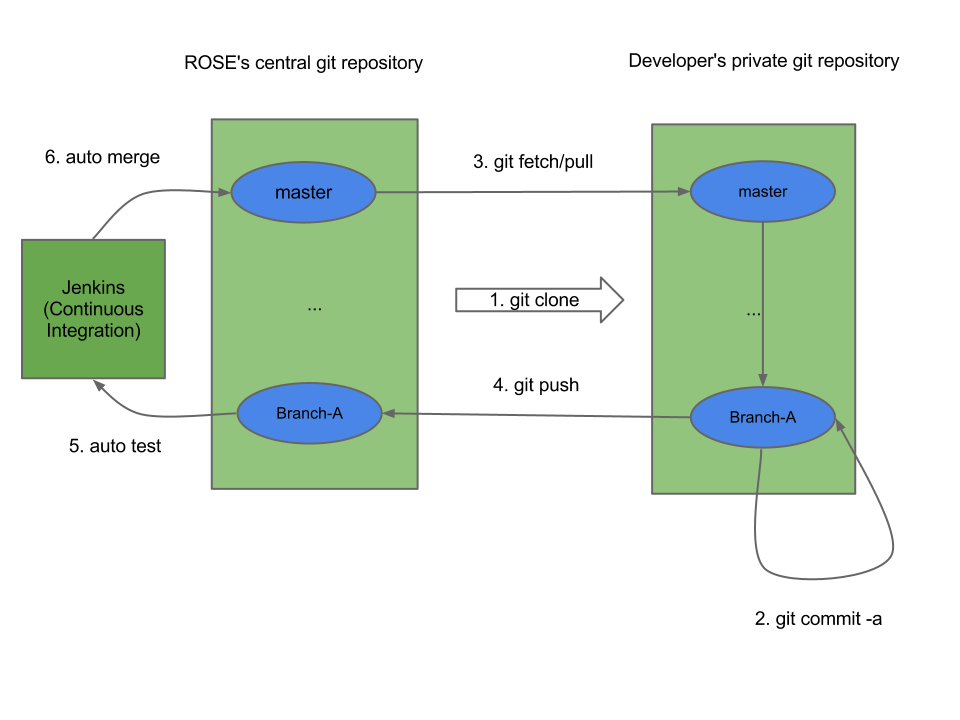
Image: File:ROSE Continuous integration using Git and Jenkins.png — Liao (CC BY-SA 3.0), via Wikimedia Commons
Why Pipeline Speed Is a Product Decision, Not Just a DevOps Detail
Slow CI/CD pipelines create real friction in the development cycle. When a developer pushes a change and waits 40 minutes for feedback, the cognitive context of that work — the mental model of what changed and why — partially degrades by the time results arrive. Research on developer flow and productivity consistently links fast feedback loops to higher deployment frequency and lower lead time, two of the core metrics in DORA assessments of software delivery performance.
The economic argument is also concrete. In a 200-person engineering organization where each developer waits an average of 20 unnecessary minutes per day for pipeline feedback, the cumulative loss is thousands of engineering hours per month — before counting the cloud compute costs of running those pipelines. Optimization is not an abstract DevOps improvement; it is a calculable return-on-investment exercise that reduces both developer frustration and infrastructure spend simultaneously.
The Real Scale of Anti-Patterns: What the 2026 Data Shows
The Shen et al. analysis examined 127,559 configuration files collected from 34,225 projects that had CI/CD workflows in place. Across the 75,201 analyzed workflows, the research categorized anti-patterns into reliability, maintainability, security, and performance dimensions. Reliability and maintainability issues were by far the most prevalent categories.
The study also found that pipeline stage usage differs significantly by programming language (χ² = 4,168.88, p < 0.001, Cramer's V = 0.063), and that domain context creates distinct operational profiles. Mobile projects, for instance, show notably higher rates of release stage and cache usage than backend-only projects. This finding has a direct practical implication: optimization strategies cannot be applied uniformly. A caching configuration that dramatically improves a Python monorepo pipeline may offer minimal benefit to a React Native mobile build where the bottleneck lies elsewhere — in code signing, provisioning, or simulator testing.
Test Selection and Prioritization: The 98% Problem
A 2025 study from Schwendner et al. (arXiv:2501.11550), accepted at ICST 2025, analyzed a large industrial CI dataset collected across 20 weeks and found that approximately 98% of pre-submit test executions pass without incident. This statistic sounds reassuring on the surface — it means the codebase is stable. But from a pipeline optimization standpoint, it reveals that in a typical pre-submit run, 49 out of 50 complete test suite executions are confirming the absence of new failures rather than catching them. The remaining 2% carries all the actionable signal.
This is not an argument for removing tests — broad coverage matters. It is a strong argument for smarter test selection. If historical patterns can reliably predict which subset of your test suite is likely to catch failures for a specific change, you could reduce pipeline runtime substantially without meaningfully reducing defect detection rates for real defects.
The Schwendner et al. paper proposes a Reinforcement Learning approach trained on language-agnostic, history-based features — essentially, past failure patterns for each test given each class of code change. The approach requires no per-test code coverage instrumentation, making it tractable for large multi-language codebases where coverage tooling is expensive or unavailable. Crucially, the researchers distinguish between two objectives that simpler approaches conflate: pre-submit pipelines should prioritize tests most likely to fail on the current change (fast developer feedback), while post-submit pipelines should prioritize tests likely to transition — passing to failing or vice versa — to catch environment-specific regressions and flakiness that escaped pre-submit gates.
Caching and Parallelism: The Fastest Wins Available Today
Before investing in sophisticated test selection infrastructure, most teams have substantial gains available from two classical techniques: build caching and pipeline parallelization. These require less upfront investment and deliver measurable results within hours of implementation.
Dependency caching avoids re-downloading and reinstalling packages whose version lock files have not changed since the previous run. On most modern CI platforms — GitHub Actions, GitLab CI, CircleCI, Jenkins — adding a cache step for npm, pip, Maven, or Gradle takes under an hour to configure and can eliminate two to eight minutes of install time on warm cache hits. For incremental compilation in languages like Go, Rust, or Java, build tools with input-hash-based caching (Bazel, Buck, Turborepo) can avoid recompiling unchanged modules entirely, producing far larger time savings at scale.
Parallelism addresses the linear execution model that many pipelines still use by default, even when tests are fully independent of one another. Most CI platforms support job-level matrix builds natively. Splitting a test suite across parallel runners — each handling a disjoint subset of tests — reduces total wall-clock time proportionally to the number of runners, minus coordination overhead. For test suites taking more than a few minutes, the time saving almost always outweighs the overhead of collecting and aggregating results from multiple jobs.
| Optimization | Typical Impact | Implementation Complexity | Best For |
|---|---|---|---|
| Dependency caching | 2–8 minutes saved per run (warm cache) | Low — a few configuration lines | All projects, immediate win |
| Parallel test runners | 50–80% reduction in test wall-clock time | Medium — requires matrix build config | Projects with large independent test suites |
| Smart test selection | 30–60% of tests safely skipped per run | High — requires historical data and tooling | Large codebases with mature test histories |
| Incremental builds | Skips unchanged modules entirely | Medium–High — requires build tool support | Monorepos and large compiled projects |
| Anti-pattern remediation | Improves reliability more than raw speed | Variable by issue type | All projects, especially growing teams |
What LLM-Assisted Configuration Can (and Cannot) Do
A 2026 paper from Aboelfotoh et al. (arXiv:2606.06662) introduces AutoPipelineAI, a system that generates CI/CD pipeline configurations from natural language descriptions by analyzing repository structure, understanding developer intent, and producing valid YAML for GitHub Actions or GitLab CI. The paper reports early evidence that repository-aware, natural-language-driven configuration generation reduces setup effort compared to manual pipeline authoring.
This addresses a genuine pain point. Writing and debugging CI/CD YAML — managing secrets, environment scoping, conditional execution, and platform-specific syntax — carries a steep learning curve that interrupts development flow, particularly for developers without deep DevOps backgrounds. AI-assisted generation lowers the barrier to getting a working pipeline in place quickly.
However, the same AI embedding that improves usability creates a new attack surface. A 2026 paper from Isbarov et al. (arXiv:2606.09935) demonstrates that LLM-based agents embedded in CI/CD workflows are vulnerable to prompt injection attacks. When AI agents review pull requests or triage issues with elevated repository permissions, malicious content in commits or PR descriptions can hijack their behavior — the paper documents eleven named attack classes across four AI providers and finds all tested providers susceptible to at least one class in their default configuration. The structural takeaway: as AI tooling proliferates in the CI/CD space, restricting pipeline agent permissions to the minimum necessary scope is a security hygiene requirement, not just a best practice.
Frequently Asked Questions
What is the single most impactful thing I can do to speed up my CI pipeline today?
For most teams, adding dependency caching to their pipeline configuration provides the fastest improvement with the lowest risk. If your pipeline installs packages on every run without a cache, you may be spending several minutes per run on downloads that produce identical results each time. On GitHub Actions, GitLab CI, and most other modern platforms, adding a cache step for your package manager typically takes under an hour to implement and can cut install time by 80–90% on warm cache hits. Measure your pipeline step timings first — the bottleneck is usually visible in your CI platform's job logs.
How do I know if test selection is removing too many tests and letting defects through?
Track your post-deploy defect rate over time and compare it to the rate before you introduced selective test execution. If production bugs appear that your full test suite would have caught, your selection criteria may be too permissive. A safe strategy is to always run the full suite on merge to the main branch, using smart selection only for pre-merge developer-facing runs. Post-submit pipelines, as the Schwendner et al. research emphasizes, serve a different purpose and need broader coverage to catch flakiness and regressions that changed tests might miss.
What CI/CD anti-patterns should I fix before anything else?
Based on the findings from the 2026 Shen et al. analysis, reliability and maintainability issues dominate the anti-pattern landscape in real CI/CD configurations. In practical terms, the highest-priority fixes are: removing hardcoded secrets or tokens from pipeline YAML (move them to encrypted environment variables or a secrets manager), adding explicit timeout definitions on long-running jobs to prevent billable runaway executions, pinning action and container references to specific version tags or commit SHAs rather than mutable tags like latest, and adding retry logic for network-dependent steps that fail intermittently. These changes improve pipeline reliability before you optimize for speed.
Bottom Line
CI/CD pipeline optimization is not a single intervention — it is an ongoing practice. The 2026 research paints a consistent picture: even well-maintained, popular open-source projects carry significant anti-pattern debt; most CI test runs spend their time confirming stability rather than catching new failures; and AI-assisted tooling is simultaneously reducing configuration barriers and expanding the attack surface. We recommend starting with the high-return, low-complexity improvements — dependency caching and job-level parallelism — before investing in advanced test selection infrastructure. Then audit your pipeline configurations for the anti-patterns that the Shen et al. analysis identifies as most prevalent: missing timeouts, mutable version pins, and hardcoded secrets. Build speed and reliability together, because a fast pipeline that intermittently breaks trust does less good than a somewhat slower one that developers can depend on.
Sources & References:
Shen B et al. "LLM-Driven CI-CD Workflow Intelligence for Cyber Systems Engineering." arXiv:2607.04579. 2026.
Schwendner D et al. "Practical Pipeline-Aware Regression Test Optimization for Continuous Integration." arXiv:2501.11550. ICST 2025 Industry Track. 2025.
Aboelfotoh YM et al. "AutoPipelineAI: Context-Aware CI/CD Pipeline Generation from Natural Language." arXiv:2606.06662. 2026.
Isbarov J et al. "GitInject: Real-World Prompt Injection Attacks in AI-Powered CI/CD Pipelines." arXiv:2606.09935. 2026.
Disclaimer: This article is for informational purposes only. Technology landscapes change rapidly; verify information with official sources before making technical decisions.