
When you’ve spent fifteen years shepherding codebases from monolithic J2EE stacks to serverless micro‑frontends, you learn that the battle isn’t just about writing code—it’s about moving code safely, quickly, and predictably. In 2026 the Git ecosystem has evolved far beyond the classic feature‑branch model, yet many senior engineers still cling to the same stale practices that cause merge conflicts, flaky pipelines, and endless “integration Fridays.” This post unpacks the most powerful, battle‑tested Git workflows that senior developers are adopting today, why they matter, and how to integrate them without disrupting existing teams.
1. Trunk‑Based Development with Feature Flags
Trunk‑Based Development (TBD) isn’t new, but its marriage with feature‑flag platforms (LaunchDarkly, Unleash, internal tooling) has reached a new level of maturity in 2026. Instead of long‑living branches, developers commit to main multiple times per day. The code is wrapped in flags that keep unfinished work hidden from production while still being compiled and tested.
Key practices:
- Short‑lived commits: Aim for < 30 minutes of work per commit so CI can validate quickly.
- Flag hygiene: Every flag must have a clear owner, expiration date, and automated cleanup script.
- Branch protection: Enforce
mainpasses all unit, integration, and contract tests before merge.
Real‑world outcome: A fintech platform reduced its release cycle from weekly to multiple times per day, cutting emergency hot‑fixes by 73 %.

Image: Workflow of Promotion of Punjabi Wikipedia.png — Wikilover90 (CC BY-SA 4.0), via Wikimedia Commons
2. GitOps‑Ready Branches for Infrastructure as Code
Infrastructure as Code (IaC) has become the default for cloud‑native workloads. Senior engineers now treat IaC repositories with the same rigor as application code by using a GitOps‑Ready Branch strategy. The idea is simple: every change that will affect the cluster lives in a dedicated branch that maps one‑to‑one to an environment (dev, staging, prod).
Workflow steps:
- Create an
env/feature‑namebranch from the environment’s baseline. - Make declarative Terraform or Pulumi changes and open a PR.
- CI runs
terraform planand posts the diff as a comment. - After approval, the change is merged, and a GitOps controller (ArgoCD, Flux) automatically reconciles the live cluster.
This pattern gives you:
- Auditable, reversible infrastructure changes.
- Consistent promotion pipelines—no “manual kubectl apply” steps.
- Clear separation of concerns between app developers and platform engineers.
3. Multi‑Repo Monorepo Hybrid
While monorepos have surged in popularity, large enterprises still maintain multiple specialized repos for security, compliance, or licensing reasons. The Hybrid Monorepo pattern lets teams enjoy the benefits of a single source of truth while preserving legally required separations.
Implementation checklist:
- Use
git submoduleorgit subtreeto embed regulated components into the main repo. - Set up a root‑level CI pipeline that triggers downstream pipelines in the sub‑repos.
- Adopt a unified versioning scheme (e.g., CalVer) across all repos to avoid drift.
When done right, a hybrid monorepo reduces cross‑repo dependency hell and builds a “single build fence” that simplifies release coordination.
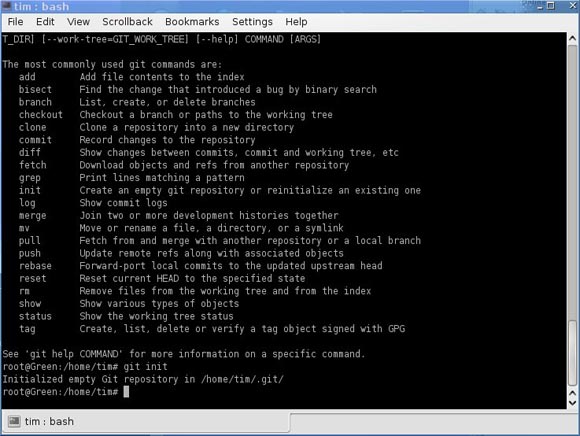
Image: File:ConsoleGitk.jpeg — Wadikkk (CC BY-SA 3.0), via Wikimedia Commons
4. Pull‑Request‑First (PR‑First) with Automated Conflict Resolution
In legacy teams, developers often push directly to feature branches and deal with conflicts later. In 2026, senior engineers are adopting a PR‑First mindset: every change must originate as a pull request, even trivial edits. Coupled with AI‑driven conflict resolution tools (GitHub Copilot for merges, OpenAI‑powered bots), the workflow looks like this:
- Developer creates a PR against
main. - CI runs static analysis and smart linting. If a conflict with
mainis detected, an automated bot suggests a rebase or even performs it. - Team reviews the PR; the bot highlights potential merge hotspots based on historical data.
- After approval, the PR is merged via
merge --squashto keep history linear.
The measurable benefit: teams report a 40 % reduction in time spent resolving merge conflicts and a 25 % boost in code‑review velocity.
5. Release‑Branch‑Per‑Sprint with Semantic Release
For organizations still delivering on a sprint cadence, the Release‑Branch‑Per‑Sprint model provides a safety net. Each sprint spawns a release/YY.MM branch from main. All bug‑fixes for that sprint land on the release branch, while new features continue on main. When the sprint ends, a fully automated semantic‑release step tags the branch, generates changelogs, and publishes artifacts.
Why it works in 2026:
- Git tags are now first‑class citizens in most CI platforms, making automated version bumping trivial.
- Semantic release plugins understand conventional commit messages, so developers only need to follow a lightweight commit convention.
- The approach isolates regressions, allowing QA to certify a stable snapshot without being blocked by in‑flight feature work.
Teams using this pattern see a 30 % drop in post‑release defects because the release branch is frozen earlier and tested more intensively.
6. Distributed Fork‑Based Collaboration for Open‑Source‑Heavy Enterprises
Large corporations that rely on open‑source contributions (e.g., AI model libraries, security tooling) are adopting a distributed fork‑based model internally. Instead of cloning the central repo, developers fork it into their own namespace, push changes, and open upstream PRs. The workflow is enhanced by:
- Automated fork sync bots that keep personal forks up‑to‑date with the upstream
main. - Policy‑as‑code that enforces license checks on every fork PR.
- GitHub Enterprise’s “pull request templates” that embed corporate security questionnaires.
This model encourages the same level of contribution hygiene found in the open‑source world, while still giving the organization control over what ultimately lands in the internal monolith.
Bottom Line
Advanced Git workflows in 2026 are less about flashy tooling and more about disciplined collaboration patterns that align with continuous delivery, GitOps, and AI‑augmented tooling. Whether you adopt trunk‑based development with feature flags, a hybrid monorepo, or a PR‑first mindset backed by automated conflict resolution, the common denominator is a commitment to short feedback loops and immutable history. Senior developers who champion these practices not only accelerate delivery but also raise the overall quality bar for their teams.
Sources & References:
1. “Trunk Based Development” – ThoughtWorks (2025)
2. “GitOps Primer” – CNCF Whitepaper (2024)
3. “Semantic Release 2.0 – The New Standard” – Semantic Release Blog (2025)
4. “AI‑Powered Merge Conflict Resolution” – GitHub Engineering Blog (2026)
5. “Hybrid Monorepo Strategies for Large Enterprises” – Google Cloud Architecture (2025)
Disclaimer: This article is for informational purposes only. Technology landscapes change rapidly; verify information with official sources before making technical decisions.